

A pop-up camper cover for winter should match your trailer’s folded dimensions and protect it from rain, snow, wind, and sun without trapping moisture. My best overall pick is the GEARFLAG Waterproof Pop-Up Camper Cover for 12–14 ft campers, while the MOFCOVER 9-Layer Rip-Stop Cover stands out for buyers seeking a more substantial layered fabric and the Nukugula Waterproof Cover suits smaller 10–12 ft trailers. The main tradeoff is between heavier weather protection and easier handling, along with getting a snug fit without excessive fabric that can flap in winter wind. Cover names and advertised features do not replace checking your camper’s measurements, roof shape, and storage exposure. Read on for how these eight options differ and which type of owner each one may suit.

Get travel and outdoor gear delivered free — and shop member deals
- Fast, free delivery on millions of items
- Access to Prime Big Deal Days deals on October 6–7
- Prime Video, Amazon Music and more included
Complete the kit


Key Takeaways
- Size is the first filter: GEARFLAG, Oxerbog, and Umbrauto are listed for 12–14 ft campers; Nukugula, DikaSun, MOFCOVER, the Pop-Up Folding Camper Cover, and VIGORVAN are listed for 10–12 ft trailers.
- MOFCOVER is the material-focused pick: Its stated 9-layer rip-stop construction gives it a distinct role for buyers prioritizing a layered fabric, though a heavier cover may take more effort to fit and remove.
- Waterproof labeling alone does not settle winter suitability: Buyers still need to check seam protection, ventilation, tie-downs, and how the cover handles local snow and wind.
- There are three direct size-group comparisons: GEARFLAG versus Oxerbog for 12–14 ft campers, and Nukugula versus DikaSun and VIGORVAN among 10–12 ft options; compare included fit details rather than relying on the product name.
- A cover is not a substitute for winterizing: Drain plumbing, manage interior moisture, and keep snow loads within the cover and camper’s safe limits.
| GEARFLAG Waterproof Pop-Up Camper Cover for 12–14 ft Campers | 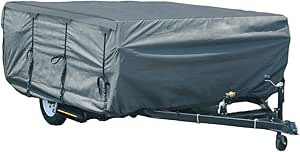 | Best for Ventilated Seasonal Storage | Compatible camper length: 12–14 ft | Maximum body width: 85 in | Top panel: Three-layer fabric | VIEW ON AMAZON | See Our Full Breakdown |
| Oxerbog Pop-Up Camper Cover, 12–14 ft |  | Best for Wind-Exposed Winter Storage | Fits: 12–14 ft pop-up campers | Material: 420D Oxford fabric | Coating: Waterproof PU and UV-resistant | VIEW ON AMAZON | See Our Full Breakdown |
| Nukugula Waterproof Pop-Up Camper Cover for 10–12 ft Trailers |  | Best for Detailed Weather-Protection Specs | Fits: 10–12 ft pop-up camper trailers | Material: Four-layer 420D silver ripstop polyester | Water pressure resistance: Over 7,500 Pa | VIEW ON AMAZON | See Our Full Breakdown |
| DikaSun Pop-Up Camper Cover, 10–12 ft |  | Best for Access While Covered | Compatible vehicle: Recreational vehicle | Fit: Vehicle-specific | Fits camper length: 10–12 ft | VIEW ON AMAZON | See Our Full Breakdown |
| MOFCOVER 9-Layer Rip-Stop Pop-Up Camper Cover, 10–12 ft, Gray |  | Best Accessory Bundle for Winter Storage | Model: MOF95231-2 | Fits camper length: 10–12 ft | Material construction: 10-layer non-woven fabric: 7 layers on top and 3 on the sides | VIEW ON AMAZON | See Our Full Breakdown |
| Pop-Up Folding Camper Cover for 10–12 ft Trailers |  | Best for Reinforced Weather Protection | Fit: Camper trailer bodies measuring 10–12 ft | Dimensions: 156 × 88 × 42 in | Construction: Eight-layer cover with four-ply reinforced sides | VIEW ON AMAZON | See Our Full Breakdown |
| Umbrauto Pop-Up Camper Cover for 12–14 ft Folding Trailers |  | Best for Larger Campers | Fit: 12–14 ft folding tent trailers | Top construction: Nine layers | Side construction: Three layers | VIEW ON AMAZON | See Our Full Breakdown |
| VIGORVAN Pop-Up Camper Cover for 10–12 ft Trailers |  | Best for Ventilation and Covered Access | Fit: 10–12 ft trailers | Model number: VGV-114 | Dimensions: 157 × 86 × 43 in | VIEW ON AMAZON | See Our Full Breakdown |
| pop up camper for winter | Ventilation | Weather protection | Securing features | Included accessories |
|---|---|---|---|---|
| GEARFLAG Waterproof Pop-Up Cam | Air vents | Rain, snow, UV exposure, wind, and moisture | Reinforced seams, adjustable straps, and elastic hem | — |
| Oxerbog Pop-Up Camper Cover | Air vents on both sides | — | Adjustable wind straps, tension panels, and elasticized corners | Storage bag and electric tongue hole cover |
| Nukugula Waterproof Pop-Up Cam | 3D air vents on both sides | — | — | — |
| DikaSun Pop-Up Camper Cover | Three vents on each side | — | — | — |
| MOFCOVER 9-Layer Rip-Stop Pop- | — | Waterproof membrane and UV-resistant fabric | Adjustable straps and reinforced corners | Jack covers, corner protectors, weighted toss bags, adhesive patch, and storage bag |
| Pop-Up Folding Camper Cover fo | — | Waterproof membrane and anti-UV treatment | — | Adhesive repair patch, toss bag, windproof straps, and storage bag |
| Umbrauto Pop-Up Camper Cover f | — | — | Adjustable straps, elastic edges, and reinforced corners | — |
| VIGORVAN Pop-Up Camper Cover f | 15 air vents | Waterproof coating and UV protection | — | Eight gutter covers, two repair patches, two windproof straps, two throwing sticks, and one storage bag |
More Details on Our Top Picks
GEARFLAG Waterproof Pop-Up Camper Cover for 12–14 ft Campers
For owners storing a 12–14-foot pop-up through wet, cold months, GEARFLAG balances weather shielding with airflow. Its three-layer top panel, reinforced seams, and adjustable straps are aimed at keeping rain and snow off while helping the cover stay put in wind. Air vents matter during winter storage because trapped moisture beneath a cover can leave surfaces damp; they support circulation, though they do not replace checking the camper periodically. Compared with the Oxerbog 12–14 ft cover, GEARFLAG lists a simpler feature set and does not specify fabric strength or water-pressure performance, while Oxerbog adds reflective strips and a tongue cover. GEARFLAG’s clear size range and storage pouch make it a straightforward fit for owners who prioritize basic protection, but buyers must confirm the camper body is no wider than 85 inches.
Pros:- Specified fit for 12–14 ft campers with a maximum body width of 85 in
- Three-layer top panel and reinforced seams add protection for storage
- Air vents support airflow beneath the cover
- Adjustable straps, elastic hem, and included storage pouch
Cons:- Fit depends on carefully measuring both camper length and body width
- Product details do not provide water-pressure or tear-strength figures
- Does not list accessories such as Oxerbog’s tongue cover
Best for: Owners storing a 12–14-foot pop-up camper who want a ventilated cover and can verify the body width before ordering.
Not ideal for: Owners whose camper exceeds 85 inches in body width or who want quantified fabric performance and extra accessories such as a tongue cover.
- Compatible camper length:12–14 ft
- Maximum body width:85 in
- Top panel:Three-layer fabric
- Weather protection:Rain, snow, UV exposure, wind, and moisture
- Ventilation:Air vents
- Securing features:Reinforced seams, adjustable straps, and elastic hem
- Included:Storage pouch
Our verdict“Choose GEARFLAG for ventilated, size-specific storage protection if your 12–14-foot camper is within the 85-inch width limit.”
Oxerbog Pop-Up Camper Cover, 12–14 ft
Oxerbog is the more specification-rich choice among the two covers here for 12–14-foot campers. Its 420D Oxford fabric, PU waterproof coating, taped seams, and stated resistance to water pressure up to 6000 Pa give buyers more concrete protection details than GEARFLAG provides. Wind straps, tension panels, and elasticized corners address the practical problem of a cover shifting or flapping during exposed storage, while vents on both sides allow airflow. Reflective strips and an electric tongue hole cover are useful additions, but the product details do not include installation directions, so first-time cover users may need to work out the setup themselves. Compared with GEARFLAG, Oxerbog offers more listed construction and accessory details; like GEARFLAG, it is restricted to a particular size range, so measurements still determine whether it is a sensible winter-storage pick.
Pros:- 420D Oxford fabric with waterproof PU coating and UV protection
- Taped seams, reinforced stitching, and stated water-pressure resistance up to 6000 Pa
- Wind straps, tension panels, and elasticized corners help secure the fit
- Includes side vents, reflective strips, a storage bag, and electric tongue hole cover
Cons:- Fit is limited to 12–14 ft pop-up campers
- Installation directions are not provided in the product details
- Its additional specifications do not remove the need to check camper dimensions
Best for: Owners of 12–14-foot pop-up campers stored in windy or exposed areas who want specified fabric protection and a tongue cover.
Not ideal for: Campers outside the 12–14 ft fit range, or buyers who need clear installation instructions before fitting a large cover.
- Fits:12–14 ft pop-up campers
- Material:420D Oxford fabric
- Coating:Waterproof PU and UV-resistant
- Water pressure resistance:Up to 6000 Pa
- Tear resistance:Up to 500 pounds
- Ventilation:Air vents on both sides
- Securing features:Adjustable wind straps, tension panels, and elasticized corners
- Included accessories:Storage bag and electric tongue hole cover
- Manufacturer part number:CZ-7T
Our verdict“Pick Oxerbog over GEARFLAG if you want more detailed fabric specifications and extra wind-management accessories for a correctly sized 12–14-foot camper.”
Nukugula Waterproof Pop-Up Camper Cover for 10–12 ft Trailers
Nukugula suits owners of 10–12-foot trailers who want protection claims spelled out rather than a basic all-weather label. The four-layer 420D ripstop polyester, water-pressure rating over 7,500 Pa, and SPF 50+ protection make its material details more specific than those supplied for DikaSun’s cover. Reinforced corners, double-stitched seams, and seven securing straps are relevant for winter storage, when wind can tug at exposed edges; vents on both sides help limit moisture buildup underneath. Reflective strips add visibility around a covered camper, although they do not change its fit or weather performance. Compared with DikaSun, Nukugula emphasizes quantified fabric and fastening details, while DikaSun offers zippered access panels. The tradeoff is a narrow size range and a listed tensile strength that may not tell buyers how the full cover performs in every storage setup.
Pros:- Four-layer 420D silver ripstop polyester construction
- Water-pressure resistance over 7,500 Pa and SPF 50+ UV protection
- Seven securing straps, reinforced corners, and double-stitched seams
- Side vents, four reflective strips, and a storage bag
Cons:- Designed only for 10–12 ft pop-up camper trailers
- Unlike DikaSun, it does not list zippered access panels
- Listed tensile strength does not describe performance for every camper shape or storage condition
Best for: Owners of 10–12-foot pop-up trailers who want stated water, UV, and fabric-strength figures for seasonal storage.
Not ideal for: Owners needing access to camper doors or compartments while covered, or campers that fall outside the 10–12 ft fit range.
- Fits:10–12 ft pop-up camper trailers
- Material:Four-layer 420D silver ripstop polyester
- Water pressure resistance:Over 7,500 Pa
- UV protection:SPF 50+
- Tensile strength:Over 230 lbs
- Securing straps:7 straps (5+2)
- Ventilation:3D air vents on both sides
- Reflective strips:4
- Warranty:1 year
Our verdict“Choose Nukugula if your 10–12-foot trailer fits and you value detailed weather-protection specifications over covered access panels.”
DikaSun Pop-Up Camper Cover, 10–12 ft
DikaSun stands apart for owners who want to reach parts of a stored 10–12-foot camper without removing the whole cover. Its zippered access panels make that more practical than the Nukugula, which focuses instead on quantified fabric protection and multiple securing straps. The nine-layer waterproof top and anti-UV protection target exposure to winter rain, snow, and sunlight, while three vents on each side support airflow and help reduce wind pressure. One tradeoff is the construction split: the top gets nine layers, but the sides are single-layer polypropylene, so the cover is less evenly layered than its top-panel description might suggest. Adjustable tension panels and buckles help with fit, but the camper still needs to match the specified length. This is the functional-access pick, not the strongest choice for buyers seeking detailed material-performance ratings.
Pros:- Nine-layer waterproof top with anti-UV protection
- Zippered access panels allow access without removing the cover
- Three vents on each side support airflow and help reduce wind pressure
- Adjustable tension panels and buckles help secure the fit
Cons:- Fit is specific to 10–12 ft pop-up campers
- Sides are single-layer polypropylene rather than nine-layer fabric
- Product details do not provide quantified water-pressure or tear-strength ratings
Best for: Owners of 10–12-foot pop-up campers who expect to reach the camper through zippered panels during covered storage.
Not ideal for: Buyers who want multi-layer construction across the sides or quantified water and tear-resistance figures.
- Compatible vehicle:Recreational vehicle
- Fit:Vehicle-specific
- Fits camper length:10–12 ft
- Top construction:Nine-layer fabric
- Side material:Polypropylene
- Water resistance:Waterproof
- UV protection:Anti-UV
- Ventilation:Three vents on each side
- Access:Zippered access panels
Our verdict“Choose DikaSun over Nukugula if access panels matter more to you than detailed fabric-strength specifications.”
MOFCOVER 9-Layer Rip-Stop Pop-Up Camper Cover, 10–12 ft, Gray
MOFCOVER is the most accessory-focused option in this group for a 10–12-foot camper. Its listed construction is a 10-layer non-woven fabric build, with seven layers on top and three on the sides, plus a waterproof membrane and UV-resistant fabric. The supplied jack covers, weighted toss bags, corner protectors, repair patch, and storage bag give owners more of the small items that can make covering and storing a camper easier. Compared with DikaSun, MOFCOVER lists more included gear, while DikaSun is the better fit for anyone who needs zippered access panels. The product requires installation and removal whenever the cover is used, and its side construction has fewer layers than its top. Buyers should also note that the title says “9-Layer” while the product details specify ten layers in total.
Pros:- Product details specify seven fabric layers on top and three on the sides
- Waterproof membrane and UV-resistant fabric target outdoor storage exposure
- Includes jack covers, weighted toss bags, corner protectors, and a repair patch
- Adjustable straps and reinforced corners support a secured fit
Cons:- Designed for 10–12 ft campers, so dimensions must match
- Requires installation and removal to use the camper
- Title says 9-layer while the detailed construction specifies 10 layers
Best for: Owners of 10–12-foot campers who want a cover bundled with jack covers, toss bags, corner protection, and a repair patch.
Not ideal for: Buyers who need to access the camper while it remains covered, want a clearly consistent layer-count description, or do not want to fit and remove a cover.
- Model:MOF95231-2
- Fits camper length:10–12 ft
- Material construction:10-layer non-woven fabric: 7 layers on top and 3 on the sides
- Weather protection:Waterproof membrane and UV-resistant fabric
- Securing features:Adjustable straps and reinforced corners
- Included accessories:Jack covers, corner protectors, weighted toss bags, adhesive patch, and storage bag
- Reflective strips:2
- Manufacturer warranty:2 years
Our verdict“Choose MOFCOVER over DikaSun if the included storage accessories matter more than zippered access while the camper is covered.”
Pop-Up Folding Camper Cover for 10–12 ft Trailers
For a 10–12 ft camper stored through winter, this cover prioritizes a reinforced build: its eight-layer construction is paired with four-ply sides, a waterproof membrane, UV treatment, and double-stitched seams. That combination is aimed at reducing exposure to wet weather and tearing, while three side straps, two all-around straps, and tension panels help hold the cover in place. Compared with the VIGORVAN cover, it emphasizes reinforced sides rather than a high vent count or a roll-up access door; Umbrauto, by contrast, fits larger 12–14 ft trailers and specifies a three-year warranty. The tradeoff is a narrower fit range and no stated warranty. I’d choose this for a correctly sized trailer needing a more heavily reinforced cover, but check the body measurements before buying.
Pros:- Waterproof membrane and UV treatment address two common sources of winter and seasonal exposure.
- Four-ply reinforced sides and double-stitched seams are designed to resist tearing.
- Side and all-around straps plus front and rear tension panels help secure the cover.
- Includes an adhesive repair patch and storage bag.
Cons:- Fit is limited to camper bodies measuring 10–12 ft, so trailer measurements need to match.
- No warranty information is specified.
- The provided details do not list ventilation features, unlike the vent-equipped VIGORVAN and Umbrauto covers.
Best for: Owners of 10–12 ft folding campers stored outdoors who want reinforced sides, weather protection, and multiple securing points.
Not ideal for: Owners of trailers outside the stated 10–12 ft body range, or buyers who need a specified warranty or built-in access door.
- Fit:Camper trailer bodies measuring 10–12 ft
- Dimensions:156 × 88 × 42 in
- Construction:Eight-layer cover with four-ply reinforced sides
- Seams:Double-stitched
- Weather protection:Waterproof membrane and anti-UV treatment
- Straps and panels:Three side straps, two all-around straps, and two front and rear tension panels
- Included accessories:Adhesive repair patch, toss bag, windproof straps, and storage bag
Our verdict“Choose this cover for a 10–12 ft camper when reinforced sides and a waterproof membrane matter more than a stated warranty or access door.”
Umbrauto Pop-Up Camper Cover for 12–14 ft Folding Trailers
Among these three, Umbrauto is the clear fit for owners of 12–14 ft folding tent trailers, while the Pop-Up Folding Camper Cover and VIGORVAN are sized for 10–12 ft models. Its nine-layer top is built for exposure to rain, snow, UV rays, dust, and scratches, and six vents give air a way to circulate under the cover. Adjustable straps, elastic edges, and reinforced corners support a closer, more secure fit. The main winter caveat is the wording: the cover is described as water resistant, not fully waterproof, so buyers seeking the stronger stated water barrier of the Pop-Up Folding Camper Cover may prefer that model if their camper fits. Umbrauto does offer a specified three-year warranty and two repair patches, but its sides have three layers rather than a stated four-ply reinforcement.
Pros:- Fits 12–14 ft folding tent trailers, unlike the two 10–12 ft covers in this group.
- Six vents help limit moisture buildup beneath the cover.
- Adjustable straps, elastic edges, and reinforced corners support a secure fit.
- Includes two repair patches and a three-year warranty.
Cons:- Described as water resistant rather than fully waterproof.
- Three-layer sides are less heavily specified than the four-ply reinforced sides of the Pop-Up Folding Camper Cover.
- The stated fit range excludes trailers outside 12–14 ft.
Best for: Owners of 12–14 ft folding tent trailers who want venting, a specified warranty, and protection from snow, UV exposure, dust, and scratches.
Not ideal for: Owners of 10–12 ft trailers who want a closer size match, or campers stored in wet conditions where a cover explicitly described as waterproof is preferred.
- Fit:12–14 ft folding tent trailers
- Top construction:Nine layers
- Side construction:Three layers
- Air vents:Six
- Water protection:Water resistant
- UV protection:Yes
- Securing features:Adjustable straps, elastic edges, and reinforced corners
- Included components:Cover, four buckle straps, two repair patches, throw bag, and storage bag
- Warranty:Three years
Our verdict“Pick Umbrauto for a 12–14 ft trailer when ventilation and a stated warranty outweigh the preference for an explicitly waterproof cover.”
VIGORVAN Pop-Up Camper Cover for 10–12 ft Trailers
VIGORVAN stands apart for the combination of 15 air vents and a roll-up access door. The vents give this cover a clear advantage over the Pop-Up Folding Camper Cover, which lists no ventilation features, while the access door lets owners reach the camper without removing the cover. Its seven-layer top and three-layer sides are paired with a waterproof coating and UV protection for a stated 10–12 ft fit. Compared with Umbrauto’s nine-layer top and six vents, VIGORVAN offers more vents and easier access, but Umbrauto is sized for larger trailers and specifies a three-year warranty. Reflective strips add visibility, though they do not replace careful securing in wind. I’d favor this option for frequent winter access and airflow, while buyers who prioritize thicker listed top construction may prefer one of the alternatives.
Pros:- Fifteen air vents provide more listed ventilation than either the six-vent Umbrauto or the cover with no specified vents.
- Roll-up access door allows entry without removing the cover.
- Waterproof coating and UV protection address common outdoor storage exposure.
- Reflective strips, windproof straps, and repair patches add practical storage features.
Cons:- Fit is limited to trailers up to 10–12 ft, making measurement checks necessary.
- The seven-layer top has fewer listed layers than Umbrauto’s nine-layer top.
- No warranty details are provided.
Best for: Owners of 10–12 ft trailers who expect to access the camper while covered and want extensive ventilation.
Not ideal for: Owners of trailers outside the 10–12 ft range, or buyers who prioritize a nine-layer top or a specified warranty.
- Fit:10–12 ft trailers
- Model number:VGV-114
- Dimensions:157 × 86 × 43 in
- Top fabric:Seven layers
- Side fabric:Three layers
- Weather protection:Waterproof coating and UV protection
- Ventilation:15 air vents
- Access and visibility:Roll-up access door and reflective strips
- Included accessories:Eight gutter covers, two repair patches, two windproof straps, two throwing sticks, and one storage bag
Our verdict“Choose VIGORVAN for a correctly sized 10–12 ft camper if frequent covered access and plentiful vents matter more than a thicker listed top or stated warranty.”

How We Picked
I compared these eight covers through the needs of a camper stored through winter: size compatibility, stated weather protection, fabric construction, fit and fastening details, and how practical the cover is to handle and maintain. Winter suitability depends on more than a waterproof label, so I also treated ventilation, seam design, wind security, and snow guidance as details buyers should verify in the current listing and manual. The supplied product names establish size ranges and, for MOFCOVER, a 9-layer rip-stop description; they do not establish unprovided specifications.
The ranking gives priority to clear fit information and useful stated construction, then separates the remaining options by size group and the details a buyer should confirm before purchase. GEARFLAG leads as the broad-use pick because it covers the 12–14 ft range and is explicitly described as waterproof. MOFCOVER ranks as the material-led alternative for smaller trailers, while Nukugula is the smaller-size waterproof option. Oxerbog, DikaSun, the Pop-Up Folding Camper Cover, Umbrauto, and VIGORVAN remain viable candidates, but buyers should compare their actual measurements, fastening system, ventilation, and care instructions before treating them as winter-ready. Since these are covers rather than insulated shelters, no ranking implies protection from freezing temperatures inside the camper.
| pop up camper for winter | Weather protection | Securing features | Included accessories |
|---|---|---|---|
| GEARFLAG Waterproof Pop-Up Cam | Rain, snow, UV exposure, wind, and moisture | Reinforced seams, adjustable straps, and elastic hem | — |
| Oxerbog Pop-Up Camper Cover | — | Adjustable wind straps, tension panels, and elasticized corners | Storage bag and electric tongue hole cover |
| Nukugula Waterproof Pop-Up Cam | — | — | — |
| DikaSun Pop-Up Camper Cover | — | — | — |
| MOFCOVER 9-Layer Rip-Stop Pop- | Waterproof membrane and UV-resistant fabric | Adjustable straps and reinforced corners | Jack covers, corner protectors, weighted toss bags, adhesive patch, and storage bag |
| Pop-Up Folding Camper Cover fo | Waterproof membrane and anti-UV treatment | — | Adhesive repair patch, toss bag, windproof straps, and storage bag |
| Umbrauto Pop-Up Camper Cover f | — | Adjustable straps, elastic edges, and reinforced corners | — |
| VIGORVAN Pop-Up Camper Cover f | Waterproof coating and UV protection | — | Eight gutter covers, two repair patches, two windproof straps, two throwing sticks, and one storage bag |
Factors to Consider When Choosing Pop Up Camper For Winter
Winter storage puts a cover through different stresses than a brief spell of rain. I would choose by the camper’s exact folded shape and the conditions at its storage site, then check how the cover stays secure and lets moisture escape. These broader checks matter even when two covers share the same advertised size.
Measure the Camper as It Sits in Storage
Measure the camper in its closed, travel-ready position, including any fixed accessories that remain in place. Advertised ranges such as 10–12 ft or 12–14 ft are useful filters, but they may not match every manufacturer’s measuring method. Check whether the listing refers to body length or overall length, and compare its size chart with your actual measurements. A cover that is too tight can strain fabric and seams, while excess material can catch wind and rub against corners. Do not size up automatically to make fitting easier; confirm the adjustment range and tie-down layout first. If your camper has an unusual roof profile or add-ons, ask the seller about compatibility before ordering.
Match Weather Protection to Your Storage Site
A sheltered carport and an exposed driveway present different demands, so focus on the conditions the cover will face rather than the word “winter.” Rain protection matters in wet climates, while prolonged snow and gusts test the cover’s shape, seams, and anchoring. Check the product information for seam construction, water resistance details, and any stated snow-load limits; do not assume a cover can support accumulated snow. In windy areas, secure fit and reinforced attachment points may matter as much as the fabric itself. Clear snow when safe and follow both the cover and camper maker’s instructions. A cover protects the exterior from weather exposure, but it does not make the camper suitable for cold-weather occupancy.
Balance Fabric Weight With Handling
Layered or rip-stop fabric can appeal to owners who want a more substantial barrier or added resistance to tearing, but a heavier cover may be harder to lift over a camper and manage alone. Lighter material can be simpler to install and remove, yet its performance depends on fabric quality, seams, and construction rather than weight alone. Look for reinforced stress points and clear care guidance, not just a layer count. Think about how often you will remove the cover for access or inspection and whether you have help during installation. MOFCOVER’s stated 9-layer rip-stop build makes this tradeoff especially relevant in this roundup. Choose a material you can handle correctly, since a poorly fitted heavy cover can still flap or pool water.
Look for Ventilation and Moisture Management
Rain exclusion is only part of winter storage: condensation can form beneath a cover when temperature swings and trapped interior moisture meet. Check for vents or other ventilation features, and make sure the fit does not block them. Avoid wrapping the camper so tightly that air cannot circulate, but do not leave loose sections that whip against the finish. Dry the camper before covering it, and inspect it periodically during storage when conditions allow. Interior moisture control also depends on the camper itself, so use its storage guidance rather than expecting the cover to manage condensation. A breathable, well-fitted setup can be more useful than a highly sealed cover in a damp storage location.
Check Fastening, Access, and Maintenance
Winter wind can turn an ill-secured cover into a source of abrasion, so inspect how it attaches at the front, rear, and underside. Confirm that straps or buckles can be tightened without pressing sharply against vulnerable camper parts. Access panels can make it easier to reach doors or inspect the trailer, but openings need secure closures when weather worsens. Check whether the care instructions call for air-drying before storage and how to remove dirt or debris without damaging the coating. A cover that is simple to fit and maintain may serve better over repeated seasons than one with features you cannot use comfortably. Keep the cover dry and stored according to its instructions when it is off the camper.
Know What a Cover Cannot Do
A camper cover shields the exterior; it does not replace winterizing plumbing, protecting batteries, or managing the interior. Drain or protect water systems according to the camper maker’s directions, and address appliances and seals as their manuals specify. Do not assume a waterproof cover will prevent freeze damage or make the trailer safe for winter camping. A cover also cannot remove the need to check roof condition, seals, and existing leaks before storage. If the camper will sit under trees or in a heavy-snow area, plan for debris and snow management as well. Treat the cover as one part of a storage plan, not the whole plan.
Frequently Asked Questions
Can I use a pop-up camper cover as protection for winter camping?
No. These products are covers for stored trailers, not insulated shelters designed for occupied cold-weather trips. They may help shield the exterior from weather while the camper is parked, but they do not provide safe indoor temperatures or protect plumbing from freezing. Remove the cover before opening or using the camper, following its instructions. For winter camping, rely on equipment and guidance specifically designed for cold-weather use.
How do I choose between the 10–12 ft and 12–14 ft cover sizes?
Measure the closed camper using the product maker’s stated method, then compare that number with the cover’s size chart. Do not base the choice only on the camper’s model name or interior sleeping length, since cover sizing can refer to a different dimension. Check how much adjustment the cover offers and whether fixed accessories affect fit. A loose cover can flap in wind, while an undersized one can pull at seams, so ask the seller if your measurement falls near a range boundary.
Is a waterproof cover enough for a camper stored where snow accumulates?
Not by itself. Waterproofing addresses water exposure, but it does not show that a cover can safely carry a heavy snow load or resist strong gusts. Look for explicit snow guidance and secure attachment details, then follow the cover and camper makers’ instructions. Plan to inspect the trailer and clear snow when conditions allow. If the storage site regularly gets heavy snow, compare a cover with a protected storage option rather than assuming fabric alone solves the problem.
Should I choose a heavier layered cover or a lighter one?
Start with the exposure level and how easily you can fit and remove the cover. A layered or rip-stop construction, such as the stated MOFCOVER build, may appeal to buyers seeking more substantial fabric, but it can be less convenient to handle. A lighter cover may be easier for one person to install, though its suitability depends on construction, fit, and fastening—not weight alone. Compare ventilation, seams, attachment points, and care instructions before deciding. The best choice is the one that fits securely and can be used as directed through the storage season.
Do I still need to winterize the camper if it is covered?
Yes. A cover does not drain water lines, protect plumbing from freezing, or prepare appliances and batteries for storage. Follow the camper manufacturer’s winterization steps and any instructions for installed equipment. Dry the camper before covering it and check for existing leaks or seal damage. Periodic inspections can catch moisture or cover movement before they lead to bigger problems. Treat the cover as exterior protection alongside, not instead of, proper winter storage.
Conclusion
Best overall: I’d start with the GEARFLAG Waterproof Cover if my camper measures within its 12–14 ft range and I want a clearly stated waterproof option. Best value: Oxerbog or DikaSun may suit shoppers comparing straightforward options in their respective size groups, but I would verify fit and fastening details before choosing. Best premium, material-focused pick: MOFCOVER is the standout for buyers drawn to its stated 9-layer rip-stop construction, provided they are comfortable handling a potentially more substantial cover. Best for beginners: I’d choose the option whose size chart, fitting instructions, and attachment points are clearest for the camper at hand; Nukugula is a practical starting point for a 10–12 ft trailer because it is explicitly described as waterproof. Best for specific needs: consider Umbrauto for a 12–14 ft folding trailer, or compare VIGORVAN and the Pop-Up Folding Camper Cover for a 10–12 ft camper based on their current fit and ventilation details. Measure first, check winter-weather guidance, and winterize the camper separately.
Halloween Picks
halloween
As an affiliate, we earn on qualifying purchases.