
To stop guessing your camping power needs, start by listing all your devices, their wattages, and daily usage hours. Calculate the total daily watt-hours, then divide this by your preferred depth of discharge (usually 50-80%) to find your battery size. Add a safety margin for cloudy days or unexpected use. Keep in mind solar input and efficiency to make certain of reliable recharging. If you want to get the most out of your setup, there’s more to discover below.

Get travel and outdoor gear delivered free with Prime
- Fast, free delivery on millions of items
- Prime Video, Amazon Music and more included
- Member-only deals all year
Key Takeaways
- List all devices’ wattage and usage time to accurately calculate total daily energy consumption.
- Use total watt-hours and desired depth of discharge to determine appropriate battery capacity.
- Incorporate safety margins for cloudy days and unexpected device use to prevent power shortages.
- Consider solar panel efficiency and sunlight hours to ensure reliable battery recharging.
- Choose higher-quality batteries with longer cycle life for better longevity and performance.
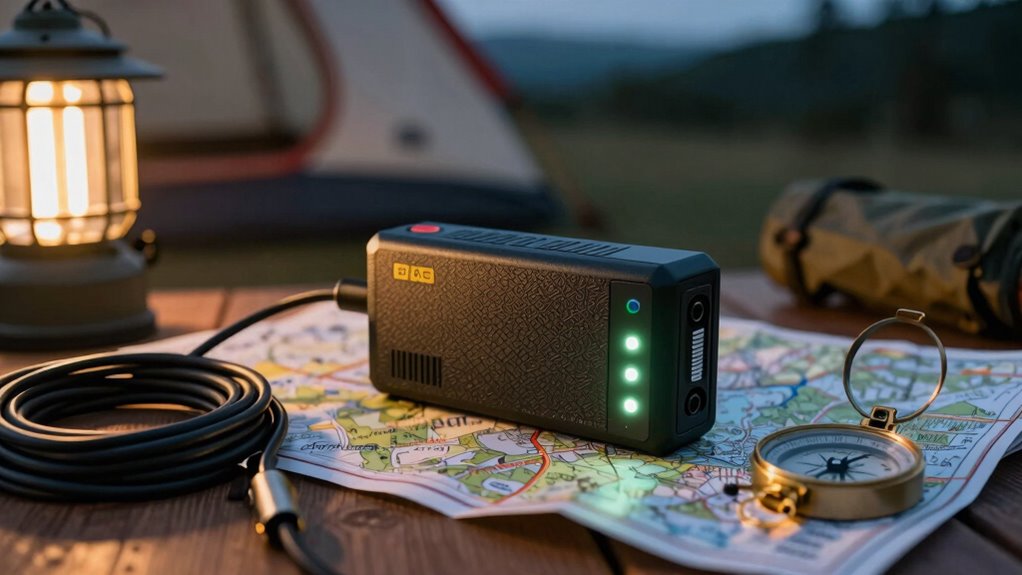
Ever wondered how to determine the right battery size for your camping needs? It’s a common question among outdoor enthusiasts, and the answer lies in understanding a simple yet effective camping battery formula. This formula helps you avoid overpacking or underestimating your power requirements, guaranteeing you get the most out of your batteries without wasting money or risking power shortages. First, figure out the total watt-hours your devices need daily. List all electronics you plan to use—lights, phones, portable fridges, and any other gear—and note their wattage and estimated usage time. Multiply each device’s wattage by its daily usage hours to get the daily watt-hours. Add these figures together for your total daily energy consumption.
Calculate your daily watt-hour needs to choose the perfect camping battery size.
Next, consider how solar efficiency impacts your battery choice. If you plan to rely on solar panels to recharge your batteries in the field, account for their efficiency and average sunlight hours. Solar efficiency determines how well your panels convert sunlight into usable energy, so knowing this helps you size your battery to match your solar input. If your panels have a 15-20% efficiency and you get about 5 hours of peak sunlight daily, you’ll need a battery capacity that can store enough energy to cover days of low sunlight. This means selecting a battery with a capacity slightly higher than your daily watt-hour needs to guarantee you’re not caught short on cloudy days. Additionally, understanding battery chemistry can influence your choice, as different types offer varying performance and longevity. Being aware of battery safety considerations is also important to ensure your setup is secure and reliable. Incorporating proper maintenance practices can further extend your battery’s lifespan and efficiency over time. Moreover, considering battery temperature sensitivity can help you optimize your setup for different outdoor conditions, ensuring consistent performance.
Battery longevity also plays a vital role in your calculations. A higher-quality battery with longer cycle life might cost more upfront but can last years longer, providing better overall value. Cheaper batteries might require replacement sooner, adding to your long-term expenses. When choosing your battery, consider its cycle life—how many full charge and discharge cycles it can handle before performance degrades. A longer cycle life usually indicates a more durable, reliable power source, which is especially important when camping in remote areas where replacements are impossible. Moreover, understanding discharge rates can help you select a battery that maintains efficiency under different load conditions, ensuring consistent power delivery.
Finally, to determine the right battery size, use this simple formula: total daily watt-hours divided by the depth of discharge you’re comfortable with (usually around 50-80%) and then add a safety margin for cloudy days or unexpected device use. This approach guarantees your battery is neither too small—leaving you power-starved—nor too large, which would be unnecessary expense. By understanding your energy needs, solar efficiency, and battery longevity, you gain a clear, practical method to stop guessing and start camping confidently with the right power setup.
As an affiliate, we earn on qualifying purchases.
Frequently Asked Questions
How Accurate Is the Camping Battery Formula for Large Power Setups?
Imagine your power needs as a vast ocean; the camping battery formula is your compass. It offers solid guidance for large setups, but accuracy depends on your load estimation and battery capacity. While it’s generally reliable, factors like device efficiency and unexpected power draws can sway results. For big setups, always add a buffer to make certain your power supply stays steady, preventing surprises during your adventure.
Can the Formula Account for Inverter Efficiency Losses?
Yes, the camping battery formula can account for inverter efficiency considerations and inverter losses. When calculating your power needs, you should include the inverter’s efficiency percentage—typically around 85-95%. By dividing your total power draw by this efficiency, you guarantee your battery capacity estimate reflects real-world conditions, helping you avoid underestimating your needs and ensuring your setup can handle inverter losses effectively.
Is the Formula Suitable for Solar-Powered Camping Systems?
Sure, your camping battery formula is perfect for solar-powered systems—because nothing says reliable like factoring in solar panels for energy input and energy storage. While it’s designed primarily for traditional power needs, you can adapt it to account for solar energy by including your solar panel’s output and storage capacity. Just remember, balancing solar panel efficiency and storage guarantees you won’t be left in the dark, no matter how sunny or cloudy it gets.
How Often Should I Recalibrate My Power Needs Using the Formula?
You should recalibrate your power needs whenever you notice significant power fluctuations or when your battery capacity changes, like after adding new devices or if your usage patterns shift. Regular recalibration guarantees your camping battery formula remains precise, helping you avoid running out of power unexpectedly. Typically, doing this every few months or after extended trips keeps your calculations dependable and your camping experience hassle-free.
Does the Formula Consider Battery Aging and Performance Decline?
Think of your battery like a car’s engine; over time, its Battery lifespan shortens, and Performance degradation occurs. The formula doesn’t automatically account for aging or declining performance, so you need to update your calculations regularly. As your battery ages, its capacity drops, making it essential to recalibrate your power needs. Keep an eye on performance and adjust the formula to guarantee your camping setup stays reliable.
Conclusion
Now that you know the camping battery formula, you’re no longer lost in the dark of uncertainty. Imagine having the power to keep your gadgets running and your campsite bright—your adventure, uninterrupted. Don’t guess your needs; calculate them. With this simple formula, you hold the key to endless camping comfort. So, turn on the lights of confidence and step into your next trip fully prepared—because knowing your power needs is the true trailblazer.
Halloween Picks
halloween
As an affiliate, we earn on qualifying purchases.