
TL;DR
A portable solar power bank stores electricity in a rechargeable battery and uses a small built-in panel to collect sunlight. That panel may extend your phone’s backup power, but it can take many hours or days to refill the bank, so compare battery capacity, panel wattage, USB output, and weight before buying. For regular, faster solar charging, pair a power bank with a separate foldable panel.
At the end of a long trail, your phone shows 8% battery just as the map turns useful. A portable solar power bank sounds like the perfect fix: set it in the sun, keep walking, and get a full battery by dinner. In practice, the battery in the bank is usually your reliable backup; its small panel is often a slow way to add a little more energy.

Get travel and outdoor gear delivered free with Prime
- Fast, free delivery on millions of items
- Prime Video, Amazon Music and more included
- Member-only deals all year
This guide explains what portable solar power banks are, how capacity and panel output affect real charging, and when a separate foldable panel makes more sense. You’ll also get a practical buying checklist for everyday carry, camping, and emergency backup, so you can match the gear to the way you’ll use it.
Treat the built-in panel on a compact solar power bank as a slow top-up; charge the battery from a wall or USB source before a trip.
Compare watt-hours when available, since mAh ratings alone can be misleading across products and USB conversion reduces delivered energy.
Check USB-C PD output and total port output against the devices you plan to charge, especially for tablets and laptops.
For frequent or faster solar charging, compare a separate foldable panel paired with a power bank.
Read the exact model’s water-resistance, temperature, and pass-through charging guidance before using it outdoors.
What a Portable Solar Power Bank Can—and Can’t—Do
A portable solar power bank combines a rechargeable battery with a small photovoltaic panel, so you can store electricity and charge a device later. The battery delivers power through its ports; the panel gathers sunlight to top up that reserve. Many compact models work best as power banks with emergency solar panels, rather than as fast solar chargers.
Think of the battery as a water bottle and the panel as a slow trickle from a tap. A full bottle can help right away, while the trickle may take a long time to refill it. For example, a hiker can charge a phone from a bank during a cloudy afternoon, but leaving a small panel clipped to a pack may add only a modest amount by evening.
Products in this category vary. Some include a built-in light, wireless charging, or several outputs. Others let you connect an external panel. A larger portable solar charger with separate foldable panels is designed to gather more sunlight, while a portable power station belongs to a higher-capacity category meant to run larger devices.
So, when a listing says “solar,” check panel size and rated wattage alongside the battery. If you need a dependable charge on arrival, charge the bank from a wall outlet before leaving and treat sunlight as a bonus. That small shift in expectations can make the gear much more useful.
Products Worth Considering

Kindle Paperwhite Signature Edition 32GB (2024 Model) – Metallic Black

GoPro HERO12 Black Waterproof Action Camera with 5.3K60 Video and 27MP Photos

Sony WH-1000XM6 Wireless Noise-Cancelling Headphones – Midnight Blue
As an affiliate, we earn on qualifying purchases.
Read Capacity and Solar Output Without Guessing
To judge a portable solar power bank, compare the energy it can store with the sunlight it can collect. Capacity often appears in milliamp-hours (mAh), while panel output appears in watts. Neither number alone tells you exactly how many hours it will take to charge your phone, because the bank loses some energy during conversion and sunlight changes throughout the day.
A 10,000 mAh rating does not mean 10,000 mAh will reach your phone. The advertised capacity is usually measured at the battery’s internal voltage, and USB conversion uses some energy along the way. When manufacturers provide watt-hours (Wh), that figure can make comparisons clearer, especially across products with different battery voltages.
The panel’s rated wattage is a best-case figure. Its actual output depends on sun angle, shade, temperature, and orientation. Picture setting a panel flat on a picnic table beneath the edge of a tree: it may collect far less energy than the same panel tilted toward a clear midday sky.
Compare the details together instead of relying on one impressive number. If you are choosing between a compact 10,000 mAh bank and a larger model, ask whether you value pocket weight or more stored energy. For a weekend trip, extra capacity might mean your phone still has power on Sunday; for an emergency kit in a drawer, a smaller bank may be easier to keep ready.
| Specification | What it tells you | Why it matters |
|---|---|---|
| Capacity | Stored energy, often listed in mAh or Wh | Helps estimate how much backup power you carry |
| Panel wattage | Best-case solar output | Hints at charging potential, subject to sunlight and placement |
| USB output | Power delivered through each port | Determines which devices can charge and how quickly |
Choose Ports That Match Your Phone, Tablet, or Laptop
Choose a portable solar power bank with ports that match your devices’ charging needs. Check the maximum output for each port and for the bank as a whole, along with supported charging standards. A USB-C port alone does not guarantee fast charging; compatible devices and supported protocols matter too.
USB-C Power Delivery (PD) can be useful for compatible phones and some tablets. For example, a traveler with a USB-C phone and a tablet may value a bank that can fast-charge one device and still has enough stored energy for the second. If you want to charge a laptop, check its required wattage and the bank’s USB-C PD output as well as its capacity.
It is easy to be distracted by extras such as wireless charging or a built-in flashlight. Those features may suit your routine, but they do not tell you whether the bank can refill quickly in the sun. A camper who mostly needs a phone for maps may get more value from adequate capacity and a strong USB-C output than from a long list of add-ons.
Before you buy, check maximum output per port and total output, supported charging standards, and whether the input can accept power from an external panel. Some banks recharge more quickly from a wall outlet or USB source than from their built-in panel. Match the specifications to the devices you actually carry, rather than paying for power you cannot use.
Pick a Setup for the Trip You Actually Take
The best setup depends on how long you travel, how often you can reach sunlight, and how much weight you want to carry. A compact bank suits daily carry and occasional backup. Longer trips can call for more stored energy and a separate foldable panel that you can position in the sun while keeping the battery in the shade.
Imagine two travelers: one spends Saturday at a sunny beach with a phone and earbuds; the other hikes for several days and relies on a phone for navigation. The first may only need a light bank charged before leaving. The second might benefit from a portable solar charger paired with a power bank, because a larger separate panel can collect more sunlight than a small panel built into a case.
Use this short checklist before choosing:
- Name your use: everyday backup, weekend trip, emergency kit, or longer off-grid travel.
- List your devices: note their charging ports and, for laptops, the required power.
- Compare stored energy: check capacity and watt-hours when available.
- Check solar options: compare panel wattage and external-panel compatibility.
- Weigh the tradeoff: more capacity and a bigger panel generally mean more bulk to carry.
For a family picnic, a small bank can keep a phone ready for calls and photos. For a multi-day hike, the bank’s weight matters every hour, but running out of power can matter more. Your route and charging opportunities should settle that tradeoff.
Use Sunlight Safely and Set Realistic Expectations
A portable solar power bank charges from sunlight, but its speed can drop sharply in cloud, shade, poor positioning, or short winter days. It can still collect some power in cloudy weather, though usually more slowly. If a small built-in panel is trying to refill a large battery, the job may take many hours or days rather than a single afternoon.
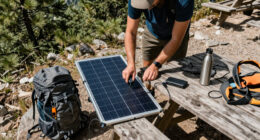
For steadier results, place the panel where it can see clear sun and adjust its angle as the sun moves. On a campsite, you might lay a foldable panel in an open patch while keeping the battery out of direct heat. Charging a phone directly from a panel can work on some products, but changing sunlight can interrupt the output; charging the bank first often gives you a more consistent supply later.
Water-resistant does not mean waterproof, and ratings apply only under the conditions the maker specifies. Ports, plugs, and covers can be weak points. Read the product’s water-resistance, drop-protection, operating-temperature, and battery-safety guidance; follow the maker’s limits, especially in very hot weather or winter cold.
Some models support pass-through charging, which lets you charge a device while the bank itself charges. That can be handy at a sunny campsite, but it may create extra heat or slow charging. Check the manufacturer’s instructions, and keep gear away from puddles and hot surfaces. If children are near a pool or open water, supervise them closely and keep charging equipment safely out of reach.
Make Your Final Choice With Five Practical Checks
A good purchase starts with your actual charging routine, not the number of features on a product page. Check the following details side by side, then decide whether the built-in panel suits occasional topping-up or you need a separate solar charger. For example, someone who carries a phone on day hikes may prefer a lighter bank, while a camper who stays several nights in clear weather may welcome a foldable panel.
- Capacity in Wh: use this where available to compare stored energy, and remember that USB conversion reduces what reaches your device.
- Panel wattage: treat it as a best-case rating, not a guaranteed daily charge.
- USB-C output and protocols: confirm they suit your phone, tablet, or laptop.
- Weight and durability: check protection ratings and limits alongside the weight you will carry.
- External-panel support and warranty: these can matter if you plan to recharge from the sun often.
Recent products often add USB-C, faster wired charging, wireless pads, lights, and multiple outputs. Those can be useful, but new features do not make a small panel collect more energy. A family preparing an emergency kit might value a clear warranty and simple ports; a backpacker may put every extra gram on the scale.
Specifications, model availability, and features change quickly. Verify current details with the manufacturer before you buy, and read the operating and care instructions for your exact model. The right setup is the one whose stored energy, solar input, and weight fit your real plans.
Frequently Asked Questions
Can a solar power bank charge on a cloudy day?
Yes, but cloud cover reduces the sunlight reaching the panel, so charging usually takes longer. Heavy cloud, shade, and poor angle can cut output sharply. A small built-in panel may add only a slow top-up.
How long does it take to charge one from the sun?
There is no single charging time: panel size, battery capacity, sunlight, angle, and charging electronics all affect it. A small built-in panel can take many hours or days to refill a large battery. Treat ideal manufacturer estimates as best-case figures, not a promise for outdoor conditions.
Can I charge my phone directly from the solar panel?
Some models allow direct charging, but changing sunlight can make the output less consistent. Charging the power bank first and then charging your phone from the stored energy often gives you steadier power. Check the product instructions for supported use.
Can a portable solar power bank charge a laptop?
Some higher-output models can charge certain laptops through USB-C Power Delivery. Check that the bank meets your laptop’s required output wattage and has enough stored energy; a compatible port alone does not guarantee a useful charge.
Is a built-in panel enough for camping?
It can offer a slow top-up in good sun, especially for occasional backup. If you need regular or faster solar charging over a longer trip, compare a larger foldable panel paired with a power bank. The extra charging potential comes with more gear to carry.
Are solar power banks waterproof?
No, not automatically. Check the exact model’s water-resistance rating and its stated limits, since exposed ports and covers can be vulnerable. Follow the maker’s guidance around rain, splashes, and storage.
Conclusion
Choose a portable solar power bank for the energy it stores, then treat sunlight as a useful but unpredictable bonus. Compare watt-hours, panel output, port ratings, weight, and care limits against the trip you actually take.
On a clear morning, a well-placed panel can quietly add to your reserve while you make breakfast. Just give it time, and keep your plans grounded in the battery you brought.