
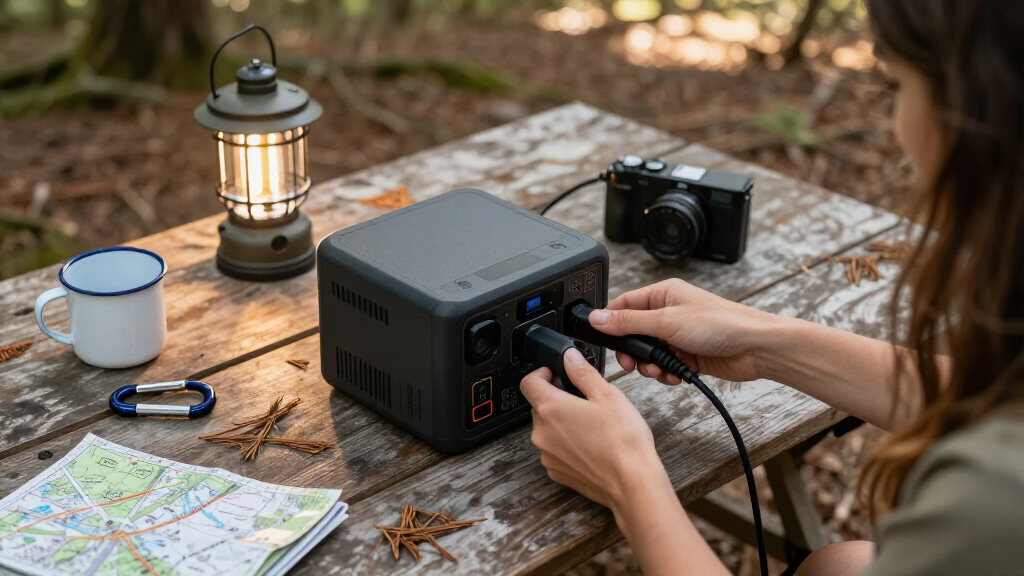

The best portable power station for camping is the Anker SOLIX C1000 Gen 2, which balances a large battery, fast recharging, and enough AC output to run a full camp kitchen without the weight penalty of bigger units. If you only need to charge phones and run LED lights, the Anker SOLIX C300 keeps things light at under 288Wh, while the BLUETTI AC180 is the stronger choice for campers who want power-tool-grade output and solar recharging on multi-day trips. The main tradeoff in this category is simple: capacity versus weight. Small 80–300Wh units are easy to carry but die quickly, while 1,000Wh+ models can run a fridge for a weekend but can weigh over 20 pounds and cost far more. Below, I break down all 15 models by capacity class, battery chemistry, and who each one actually suits.

Get travel and outdoor gear delivered free with Prime
- Fast, free delivery on millions of items
- Prime Video, Amazon Music and more included
- Member-only deals all year
Complete the kit


Key Takeaways
- Capacity classes mattered more than brand: the 1,000Wh+ units (Anker C1000 Gen 2, BLUETTI AC180, Jackery Explorer 1000 v2) form a clear tier for base-camp and RV-style camping, while everything under 300Wh is best treated as a phone-and-lights battery, not a power source for cooking.
- LiFePO4 battery chemistry was the single biggest durability differentiator — models like the BLUETTI AC180, Daran 192Wh, and VTOMAN FlashSpeed 300 offer 3,000+ cycle lifespans, while older-chemistry budget units like the GRECELL 330W may degrade after far fewer summers of use.
- Ultra-compact 80–120Wh stations (MARBERO, HOWEASY, Daran 89.6Wh) are tempting for backpack-style trips, but their 120W surge limits mean many electric blankets, kettles, and even some pump chargers won’t start on them at all.
- The 250–300Wh class was the most crowded and most redundant segment — the Anker SOLIX C300, VTOMAN FlashSpeed 300, BLUETTI Elite 30 V2, and GRECELL 330W all overlap heavily, and recharging speed plus battery chemistry, not raw wattage, decided the ranking.
- The GRECELL 519Wh emerged as the standout mid-size value pick, filling the gap between weekend-capable power and carry weight — a slot where most brands force you to choose one or the other.
| Anker SOLIX C1000 Gen 2 Portable Power Station |  | Best Overall | Capacity: 1,024Wh LiFePO4 | Continuous Output: 2,000W | Peak Output: 3,000W | VIEW LATEST PRICE | See Our Full Breakdown |
| BLUETTI Portable Power Station AC180 |  | Best for High-Draw Appliances | Capacity: 1,152Wh | Battery Type: LiFePO4 | Continuous Output: 1,800W (2,700W boosted) | VIEW LATEST PRICE | See Our Full Breakdown |
| Jackery Explorer 1000 v2 Portable Power Station |  | Best Balanced Mid-Size | Capacity: 1,070Wh | Battery Type: LFP | AC Output: 1,500W (3,000W surge) | VIEW LATEST PRICE | See Our Full Breakdown |
| Daran 300W Portable Power Station (600W Surge) |  | Best Ultra-Light Value | Capacity: 192Wh | Battery Type: LiFePO4 | AC Output: 300W (600W peak) | VIEW LATEST PRICE | See Our Full Breakdown |
| Jackery Explorer 300 Portable Power Station |  | Best Compact Weekend Pick | Capacity: 292Wh | Battery Type: LiFePO4 (4,000+ cycles) | Output: 300W | VIEW LATEST PRICE | See Our Full Breakdown |
| ALLWEI Portable Power Station 300W, 256Wh Solar Generator LiFePO4 Battery |  | Best Mid-Size for Multi-Day Trips | Capacity: 256Wh | Continuous Power: 300W (600W surge) | Battery Type: LiFePO4, 3000 cycles | VIEW LATEST PRICE | See Our Full Breakdown |
| Portable Power Station 120W, 110V Power Bank with DC and AC Outlets |  | Best Budget Starter Unit | Capacity: 97.6Wh / 26,400mAh | Output: 120W, 120V AC | Ports: 6 (AC, DC, USB-A, USB-C) | VIEW LATEST PRICE | See Our Full Breakdown |
| MARBERO Portable Power Station 88Wh, 120W Surge, Solar Generator 24,000mAh |  | Best Ultra-Light Grab-and-Go | Capacity: 88Wh / 24,000mAh | Output: 80W continuous, 120W surge | Ports: 8 total (AC, DC, USB-A, USB-C PD) | VIEW LATEST PRICE | See Our Full Breakdown |
| HOWEASY Portable Power Station, 120W (240W Peak) Solar Generator |  | Best for Emergency Kits and Gloveboxes | Output: 120W running, 240W peak | Ports: 8 total (AC, USB-C, QC USB, DC) | Weight: 2.3 lbs | VIEW LATEST PRICE | See Our Full Breakdown |
| Daran Portable Power Station 89.6Wh LiFePO4 Battery with 100W Output and Fast Charging |  | Best Small Unit for Long-Term Ownership | Capacity: 89.6Wh | Battery Type: LiFePO4, 3500+ cycles | Output: 100W continuous, 200W peak | VIEW LATEST PRICE | See Our Full Breakdown |
| VTOMAN FlashSpeed 300 Portable Power Station, 300W 230Wh |  | Best Battery Longevity in a Small Package | Capacity: 230Wh | Output Power: 300W | Battery Type: LiFePO4 (3,000+ cycles) | VIEW LATEST PRICE | See Our Full Breakdown |
| BLUETTI Elite 30 V2 Portable Power Station 288Wh 600W LFP |  | Best for CPAP and Essential Devices | Capacity: 288Wh | Continuous Power: 600W | Surge Power: 1,500W (Power Lifting Mode) | VIEW LATEST PRICE | See Our Full Breakdown |
| Portable Power Station 330W, GRECELL 230.88Wh Solar Generator |  | Best Budget-Friendly Starter | Capacity: 230.88Wh | Output: 330W (600W surge), pure sine wave | USB-C PD: 60W | VIEW LATEST PRICE | See Our Full Breakdown |
| Anker SOLIX C300 Portable Power Station, 288Wh |  | Best Fast-Recharging Compact | Capacity: 288Wh | Power Output: 300W (600W surge) | Ports: 3x AC, 1x car socket, 2x USB-C 140W, 1x USB-C 15W, 1x USB-A 12W | VIEW LATEST PRICE | See Our Full Breakdown |
| GRECELL Portable Power Station 500W, 519Wh Solar Generator |  | Best Capacity per Dollar | Capacity: 519Wh | Power Output: 500W | Battery Type: Lithium-ion | VIEW LATEST PRICE | See Our Full Breakdown |
| portable power stations for camping | Capacity | Weight | Battery Type |
|---|---|---|---|
| Anker SOLIX C1000 Gen 2 Portab | 1,024Wh LiFePO4 | 11.3 kg (24.9 lbs) | — |
| BLUETTI Portable Power Station | 1,152Wh | — | LiFePO4 |
| Jackery Explorer 1000 v2 Porta | 1,070Wh | 23.8 lbs | LFP |
| Daran 300W Portable Power Stat | 192Wh | 5.84 lbs | LiFePO4 |
| Jackery Explorer 300 Portable | 292Wh | 7.5 lbs | LiFePO4 (4,000+ cycles) |
| ALLWEI Portable Power Station | 256Wh | 6.4 lbs | LiFePO4, 3000 cycles |
| Portable Power Station 120W | 97.6Wh / 26,400mAh | 2.2 lbs | — |
| MARBERO Portable Power Station | 88Wh / 24,000mAh | 1.04 kg (~2.3 lbs) | — |
| HOWEASY Portable Power Station | — | 2.3 lbs | — |
| Daran Portable Power Station 8 | 89.6Wh | 2.54 lbs | LiFePO4, 3500+ cycles |
| VTOMAN FlashSpeed 300 Portable | 230Wh | 7 lbs | LiFePO4 (3,000+ cycles) |
| BLUETTI Elite 30 V2 Portable P | 288Wh | 9.4 lbs | — |
| Portable Power Station 330W | 230.88Wh | — | — |
| Anker SOLIX C300 Portable Powe | 288Wh | — | LiFePO4, 3,000 cycles |
| GRECELL Portable Power Station | 519Wh | — | Lithium-ion |
More Details on Our Top Picks
Anker SOLIX C1000 Gen 2 Portable Power Station
The Anker SOLIX C1000 Gen 2 earns the top spot because it solves camping’s most annoying problem: waiting around for a depleted power station to recharge. Its 49-minute AC recharge is roughly twice as fast as the BLUETTI AC180 and the Jackery Explorer 1000 v2, which matters when you can charge up at a campsite outlet or a quick stop between sites. With 2,000W of continuous output, it handles kettles, portable induction cooktops, and power tools — gear that would trip the 300W units elsewhere in this lineup. The tradeoff is weight: at 11.3 kg, this is basecamp gear, not backpacking gear. Compared with the smaller Jackery Explorer 300, this model makes sense only if you genuinely need the capacity, because every extra watt-hour adds bulk to carry.
Pros:- 49-minute full AC recharge means less downtime between campsites
- 2,000W continuous output runs high-draw appliances smaller units can’t touch
- 1.8-hour solar recharge is among the fastest off-grid refills available
- Nine outlets let the whole campsite charge at once
Cons:- At 11.3 kg, it’s one of the heaviest picks for its capacity class
- Advanced power management is gated behind the companion app
- Overkill in price and bulk for weekend phone-and-laptop charging
Best for: Car campers and families who run multiple devices plus high-wattage appliances like electric coolers, kettles, or cooktops
Not ideal for: Backpackers or paddlers — at 11.3 kg it’s far too heavy to carry any real distance
- Capacity:1,024Wh LiFePO4
- Continuous Output:2,000W
- Peak Output:3,000W
- AC Recharge Time:49 minutes
- Solar Recharge Time:1.8 hours
- Total Outlets:9
- Weight:11.3 kg (24.9 lbs)
- Dimensions:15.1 x 8.2 x 9.6 inches
Our verdict“If you camp from a vehicle and want one station that powers everything and recharges before lunch, this is the one to buy.”
BLUETTI Portable Power Station AC180
Where the Anker SOLIX C1000 wins on recharge speed, the BLUETTI AC180 wins on raw muscle per outlet. Its 1,800W continuous output — boostable to 2,700W via the app — gives it headroom the Jackery Explorer 1000 v2 (1,500W) simply doesn’t have, so a hair dryer or microwave won’t shut it down. A one-hour AC recharge keeps downtime short, and the 500W solar input means real off-grid recovery rather than a trickle. The honest drawback is portability: BLUETTI doesn’t publish a weight for this unit, and units in this capacity class typically land well above the Jackery 1000 v2’s 23.8 lbs. With only two AC outlets, you’ll want a power strip for a busy campsite — a spot where the Anker’s nine ports show their advantage.
Pros:- App-based boost to 2,700W handles surge-heavy appliances
- One-hour full AC recharge keeps trips moving
- 500W solar input enables meaningful off-grid recharging
- Doubles as a UPS for home essentials between trips
Cons:- Only two AC outlets limits simultaneous appliance use
- Unpublished weight makes packing plans harder, and rivals are lighter
- Rapid charging demands high-wattage input not every campsite offers
Best for: Campers and van-lifers who want to occasionally run power-hungry appliances like microwaves or hair dryers off-grid
Not ideal for: Minimalists charging phones and a lantern — the capacity and output go unused while the bulk follows you everywhere
- Capacity:1,152Wh
- Battery Type:LiFePO4
- Continuous Output:1,800W (2,700W boosted)
- AC Outlets:2
- AC Recharge Time:1 hour
- Solar Input:500W
Our verdict“The pick when you need to actually run big appliances at camp, not just charge gadgets — as long as you can live with the heft.”
Jackery Explorer 1000 v2 Portable Power Station
The Jackery Explorer 1000 v2 lands in the sweet spot between the overpowered Anker SOLIX C1000 and the featherweight Jackery Explorer 300. At 23.8 lbs with 1,070Wh of capacity, it’s lighter than the Anker while still carrying enough energy for a long weekend of laptops, cameras, drones, and a 12V cooler. The 1,500W output covers most camping appliances, though it lacks the AC180’s boost headroom for true power hogs. What justifies its place is endurance: Jackery rates the LFP cells for over a decade of use, meaning this outlasts the smaller Daran 300W even after years of weekly trips. The catch is ecosystem lock-in — fast solar charging works best with Jackery’s own panels, adding cost if you already own third-party gear.
Pros:- Full capacity recharge in about 1 hour with fast charging
- 1,070Wh runs a weekend of gadgets, cameras, and a portable cooler
- LFP battery rated for 10+ years of service life
- Seven ports including two USB-C cover every charging scenario
Cons:- Optimal solar charging depends on proprietary Jackery panels
- 1,500W output can’t match the AC180 for surge-heavy appliances
- No PO Box delivery — requires a physical shipping address
Best for: Solo travelers and couples doing multi-day trips who want kilowatt-hour capacity without kilogram-heavy bulk
Not ideal for: Buyers who already own non-Jackery solar panels, since charging efficiency suffers outside the brand ecosystem
- Capacity:1,070Wh
- Battery Type:LFP
- AC Output:1,500W (3,000W surge)
- AC Recharge Time:1 hour fast / 1.7 hours default
- Ports:3 AC, 2 USB-C, 1 USB-A, 1 DC car port
- Weight:23.8 lbs
- App Control:Yes
Our verdict“The most sensible all-rounder for multi-day campers who want big capacity in the lightest possible package.”
Daran 300W Portable Power Station (600W Surge)
Not everyone needs a kilowatt-hour at camp. The Daran 300W makes the list because it strips a power station down to what a simple overnighter actually requires, and it does so at 5.84 lbs — nearly 18 lbs lighter than the Jackery Explorer 1000 v2. Its eight ports across AC, USB-C, USB-A, and DC beat the port selection of the similarly sized Jackery Explorer 300, and the built-in LED light with SOS and strobe modes replaces a separate camp lantern. The 192Wh capacity is the real limit: this powers phones, headlamps, a drone, and maybe a small fan, but an electric kettle or portable fridge is off the table — the VTOMAN FlashSpeed 300 and BLUETTI Elite 30 V2 occupy similar territory with different tradeoffs. With 3,500+ rated cycles, it will outlive many trips’ worth of abuse.
Pros:- At 5.84 lbs, it’s genuinely carryable to a tent site or trailhead
- Eight-in-1 port array covers every small-device connector
- Built-in LED with SOS mode doubles as an emergency light
- LiFePO4 cells rated for over 3,500 cycles
Cons:- 192Wh runs dry quickly with anything beyond phones and lights
- No app connectivity or usage telemetry
- Solar recharge slows dramatically in weak sunlight
Best for: Tent campers, hikers with a base camp, and emergency-kit builders who need light, affordable power for phones, lights, and small devices
Not ideal for: Anyone running a 12V fridge, kettle, or cooking appliance — the 300W ceiling and 192Wh capacity won’t sustain them
- Capacity:192Wh
- Battery Type:LiFePO4
- AC Output:300W (600W peak)
- Outlets:2 AC, 2 USB-C (60W PD), 1 USB-A, 1 car outlet, 2 DC5521
- Recharging:AC, solar, or car outlet
- Charge Cycles:3,500+
- Weight:5.84 lbs
- Dimensions:8.4 x 5.3 x 7.4 inches
Our verdict“The right pick when your camping power needs are genuinely modest and every ounce counts.”
Jackery Explorer 300 Portable Power Station
The Jackery Explorer 300 fills a slightly different niche than the Daran 300W: it’s the refined, battery-durable option for repeated weekend use rather than the budget lightweight. Its LiFePO4 cells rated for 4,000+ cycles edge out the Daran’s 3,500, which matters if this lives in your car year-round. The integrated handle and 7.5 lb frame make it the easiest grab-and-go option in this entire roundup — no comparing, just toss it in the trunk. Six ports, including two AC, handle a weekend of phone, camera, and drone charging, and solar gets it to 80% in under three hours with the right panels. The ceiling is obvious: 292Wh and 300W output means no kettles, no fridges, no hair dryers. The Anker SOLIX C300 offers a similar footprint if you prefer that brand’s app ecosystem.
Pros:- 4,000+ cycle LiFePO4 battery outlasts most rivals in this size class
- 7.5 lbs with a built-in handle makes it effortless to move
- Reaches 80% via solar in under 3 hours with compatible panels
- Six outlets span AC, USB-C, USB-A, and car-port charging
Cons:- Solar panel sold separately, adding to real cost
- 292Wh capacity limits trips to two or three days of light use
- 300W output cannot start most compressor fridges or kettles
Best for: Weekend car campers and van weekenders who want a tough, long-lived small station for phones, cameras, and lights
Not ideal for: Anyone expecting to run appliances — the 300W limit and small capacity rule out anything that heats or cools
- Capacity:292Wh
- Battery Type:LiFePO4 (4,000+ cycles)
- Output:300W
- Outlets:2 AC, 1 USB-C, 2 USB-A, 1 car port
- Charge Time:4 hours (80% in under 3 hours via solar)
- Weight:7.5 lbs
- Dimensions:9.1 x 5.2 x 7.8 inches
Our verdict“A dependable, pocket-sized weekend workhorse for light loads — just don’t ask it to cook.”
ALLWEI Portable Power Station 300W, 256Wh Solar Generator LiFePO4 Battery
Among the sub-300Wh options in this roundup, the ALLWEI 256Wh carves out a clear niche: it is the only lightweight model here pairing LiFePO4 chemistry with 3000 charge cycles, meaning it will survive roughly five times more seasons than the standard lithium-ion units like the MARBERO 88Wh or HOWEASY 120W. That longevity matters for campers who pack out several times a year. Compared with the Jackery Explorer 300, it trades a little brand polish for dual charging capability — topping up via AC and solar simultaneously cuts recharge time to roughly two hours, which is genuinely useful when sunlight is inconsistent. The tradeoff is weight: at 6.4 lbs, it is nearly triple the featherweight picks in this batch, and the solar panel is sold separately. Still, for a weekend of phone, camera, lantern, and laptop charging, the capacity headroom is worth carrying.
Pros:- LiFePO4 battery rated for 3000 cycles, far outlasting lithium-ion rivals
- Dual charging (AC + solar) cuts recharge time to 2-2.5 hours
- 300W continuous output handles more gear than the 80-120W picks in this batch
- Six output ports let you charge a phone, camera, and laptop at once
Cons:- Solar panel must be purchased separately, adding to the real cost
- 256Wh will not run anything beyond 300W, ruling out most kitchen appliances
Best for: Weekend campers and van lifers who want durable battery chemistry and enough capacity for two to three days of device charging without stepping up to a heavy 1000Wh unit
Not ideal for: Ultra-light backpackers and anyone hoping to run a portable fridge, kettle, or other appliance beyond 300W — it will shut down, and the weight works against minimalists
- Capacity:256Wh
- Continuous Power:300W (600W surge)
- Battery Type:LiFePO4, 3000 cycles
- Weight:6.4 lbs
- Charge Time:3.5-4 hrs AC, 2-2.5 hrs dual input
- Ports:1 AC, 1 USB-C PD, 1 USB-A, 2 DC5521, 1 car socket
Our verdict“The most sensible mid-size pick here for campers who prioritize battery lifespan and multi-day capacity over featherweight portability.”
Portable Power Station 120W, 110V Power Bank with DC and AC Outlets
This 97.6Wh station sits at the value end of the lineup, and its appeal is straightforward: a full set of AC, DC, USB, and USB-C outlets at a price point where competitors often strip features away. Where the Daran 89.6Wh counters with LiFePO4 durability, this unit leans on practicality instead — a built-in cooling fan, five layers of circuit protection, and recharging via USB-C, car adapter, or solar. At 2.2 lbs with a carry handle, it slots into a car-camping bin without a second thought. The honest limitation is capacity: 97.6Wh is roughly two phone recharges plus a night of lantern duty, and the 120W ceiling means no laptops with big chargers, no fridges, no kettles. Compared with the VTOMAN FlashSpeed 300, you give up half the capacity to save weight and money — a reasonable trade for occasional overnights rather than expeditions.
Pros:- Six output ports cover every common plug type
- Recharges three ways: solar, USB-C, and car adapter
- Comprehensive safety protections with an active cooling fan
- Genuinely light at 2.2 lbs with a carry handle
Cons:- 120W output cap excludes most laptops with high-wattage chargers and any small appliance
- 97.6Wh capacity suits a single night, not a weekend
Best for: First-time campers and casual overnighters who want a cheap, low-risk way to keep phones and small lights charged without committing to a larger station
Not ideal for: Anyone charging drones, cameras on multi-day shoots, or running a CPAP — the sub-100Wh capacity will run dry before morning
- Capacity:97.6Wh / 26,400mAh
- Output:120W, 120V AC
- Ports:6 (AC, DC, USB-A, USB-C)
- Weight:2.2 lbs
- Dimensions:5.7 x 4.4 x 4.1 inches
- Recharging:Solar, USB-C, car adapter (panel not included)
- Safety:Short circuit, over-current, over-voltage, overload, overheat protection
Our verdict“A sensible, low-commitment entry point for light-duty campers who value portability and price over endurance.”
MARBERO Portable Power Station 88Wh, 120W Surge, Solar Generator 24,000mAh
At just over two pounds, the MARBERO 88Wh is the lightest full-featured station in this batch, and its eight ports punch above its size class. The standout for campers is the built-in LED flashlight with multiple brightness levels — a small thing that means one less gadget in the pack. Compared with the similarly sized HOWEASY 120W, the MARBERO wins on fast AC recharging and port variety, while both share the same fundamental constraint: 80-120W of output means phones, headlamps, and small fans only. The 88Wh capacity is the real ceiling here — fine for a single overnight, thin for anything longer. It also uses a standard lithium-ion cell rather than the LiFePO4 chemistry in the Daran 89.6Wh, so expect fewer charge cycles over its life. As a glovebox or daypack emergency unit, though, the size-to-usefulness ratio is hard to beat.
Pros:- Lightest full-featured option here at roughly 2.3 lbs
- Eight output ports including AC, DC, USB-C PD, and USB-A
- Integrated LED flashlight with multiple brightness modes
- Fast recharging with the included adapter
Cons:- 88Wh capacity limits it to roughly one overnight of light use
- Lithium-ion chemistry offers fewer charge cycles than LiFePO4 rivals like the Daran
Best for: Day hikers, kayak campers, and car travelers who want emergency phone and light power in a bag they forget they are carrying
Not ideal for: Multi-day base campers or anyone running a 12V fridge or CPAP — the capacity and wattage ceiling are both too low
- Capacity:88Wh / 24,000mAh
- Output:80W continuous, 120W surge
- Ports:8 total (AC, DC, USB-A, USB-C PD)
- Weight:1.04 kg (~2.3 lbs)
- Dimensions:6.5 x 4.6 x 3.1 inches
- Recharging:AC, solar, battery
- Extras:LED flashlight, BMS safety system
Our verdict“The pick when weight is the deciding factor and a phone-and-flashlight power budget is enough for the trip.”
HOWEASY Portable Power Station, 120W (240W Peak) Solar Generator
The HOWEASY 120W is designed less for ambitious camping and more as a set-and-forget emergency unit — the kind of thing that lives in a car trunk until a dead phone or a power outage makes it essential. Its differentiator in this lineup is the 24-month warranty, longer than most rivals here, plus a hidden handle and multi-mode LED lighting that make it a credible standalone lantern replacement. Against the MARBERO 88Wh, it offers a slightly higher peak rating (240W) and a similarly broad port spread across eight outlets. Against the ALLWEI 256Wh, it is obviously the junior option: roughly four hours of runtime at full load versus a full weekend of device charging. The capacity is small and the solar panel is not bundled, so off-grid recharging requires an extra purchase. For its intended job — occasional outages, road-trip top-ups, light overnight use — the tradeoffs are acceptable ones.
Pros:- 24-month warranty, the longest coverage in this batch
- Eight output ports including QC USB and USB-C
- Hidden handle and multi-mode LED lighting for emergency use
- Three recharge paths: solar, AC, and car socket
Cons:- Only about 4 hours of runtime at full load
- Solar panel sold separately
- 120W maximum output rules out most appliances and larger laptop chargers
Best for: Drivers and households who want a modest, warrantied backup power source for outages and roadside emergencies more than for serious off-grid camping
Not ideal for: Campers planning to run anything beyond phones, tablets, and small lights — the 120W ceiling and short runtime will disappoint
- Output:120W running, 240W peak
- Ports:8 total (AC, USB-C, QC USB, DC)
- Weight:2.3 lbs
- Dimensions:6.6 x 3 x 4 inches
- Runtime:~4 hours at full load
- Recharging:Solar, AC, car socket (panel not included)
- Warranty:24 months
Our verdict“A reasonable pick if your primary scenario is an emergency kit rather than a powered campsite.”
Daran Portable Power Station 89.6Wh LiFePO4 Battery with 100W Output and Fast Charging
Most sub-100Wh stations cut corners on battery chemistry, but the Daran 89.6Wh pairs its compact frame with a LiFePO4 cell rated for 3500+ cycles — meaning it should outlast the lithium-ion MARBERO and HOWEASY units several times over, which changes the math if you camp yearly for a decade. It is also the fastest recharging small unit here, hitting 80% in roughly 90 minutes from a wall socket, and its dual AC sockets, dual USB-C, and dual USB-A port spread is unusually generous for this size class. The 100W continuous output is the constraint: small laptops, cameras, lights, and fans are fine; anything hungrier needs the ALLWEI 256Wh or bigger. A 12-point BMS protection suite and quiet operation round out a package clearly aimed at owners who buy once. Just remember the solar panel is extra, and there is no included accessory bundle to speak of.
Pros:- LiFePO4 chemistry rated for 3500+ cycles, the best longevity in this batch
- 0-80% recharge in about 1.5 hours
- Six ports including two AC sockets and two USB-C
- Quiet operation with 12-point BMS safety protection
Cons:- 100W output ceiling excludes most appliances and higher-wattage gear
- Solar panel sold separately and no notable included accessories
Best for: Campers who want a small, durable unit they will still be using in eight to ten years, and who mostly charge phones, cameras, and small laptops
Not ideal for: Anyone needing appliance-level output or multi-day capacity — 89.6Wh and 100W cap this firmly in the personal-device category
- Capacity:89.6Wh
- Battery Type:LiFePO4, 3500+ cycles
- Output:100W continuous, 200W peak
- Ports:2 AC, 2 USB-C, 2 USB-A, DC5521
- Weight:2.54 lbs
- Charge Speed:0-80% in 1.5 hours (AC)
- Recharging:AC, USB-C PD, car, solar (panel not included)
Our verdict“The small-format pick for longevity-minded buyers who value cycle life and fast recharging over raw capacity.”
VTOMAN FlashSpeed 300 Portable Power Station, 300W 230Wh
What separates the FlashSpeed 300 from most sub-250Wh units is its LiFePO4 chemistry rated for over 3,000 cycles — roughly six times the lifespan of the lithium-ion pack inside the GRECELL 500W. That chemistry is why this model makes sense for campers who buy once and want the battery to still hold strong after years of weekend trips. Compared with the similarly sized Anker SOLIX C300, the VTOMAN trades fast USB-C charging for a broader spread of seven outputs, letting a whole tent’s worth of phones, lights, and headlamps recharge at once. The tradeoff is raw grunt: at 300W, it runs small electronics happily but stalls on anything with a heating element, and there’s no app connectivity for remote monitoring. For a lightweight base-camp charging hub, though, the durability argument is hard to beat.
Pros:- LiFePO4 battery rated for 3,000+ cycles, far outlasting standard lithium-ion packs
- Seven simultaneous outputs keep a group’s devices topped up
- Four recharge methods including USB-C PD for flexibility
- 7 lb weight makes it genuinely packable
Cons:- 300W ceiling rules out most heating and cooking gear
- No app or Wi-Fi connectivity for monitoring
- 230Wh capacity runs dry quickly on multi-day trips without solar
Best for: Weekend campers who want a light unit that survives years of frequent charge cycles
Not ideal for: Anyone hoping to run a kettle, hot plate, or other 300W+ appliance from a single station
- Capacity:230Wh
- Output Power:300W
- Battery Type:LiFePO4 (3,000+ cycles)
- Outlets:7 total
- Input Charging:AC, Solar, Car, USB-C PD
- Weight:7 lbs
- Dimensions:10.24 x 4.72 x 7.87 inches
Our verdict“A compact buy-it-for-years option for campers who prioritize battery lifespan over raw wattage.”
BLUETTI Elite 30 V2 Portable Power Station 288Wh 600W LFP
The Elite 30 V2 earns its spot by pairing a modest 288Wh capacity with a genuinely useful 600W continuous output — double what the VTOMAN FlashSpeed 300 or Anker SOLIX C300 can deliver in the same weight class. With Power Lifting Mode stretching to 1,500W for surge-heavy devices, it handles small appliances and medical equipment like CPAP machines that would trip lesser units. The UPS pass-through feature is another differentiator: compared with the GRECELL 330W, which lacks any backup switchover, the BLUETTI keeps critical devices running uninterrupted during a power cut at home between camping trips. The compromises are real, though — 288Wh still disappears overnight if you’re running anything hungry, and squeezing the rated solar performance means investing in a compatible panel.
Pros:- 600W continuous output doubles what rival 288Wh units typically offer
- UPS function protects critical devices during outages
- 1,500W Power Lifting surge covers demanding startup loads
- Fast adjustable wall charging up to 380W
Cons:- 288Wh capacity limits multi-day use without solar
- Full solar performance requires a compatible panel investment
Best for: CPAP users and campers who need reliable overnight power for essential or medical devices
Not ideal for: Power-hungry campers running multiple appliances — the 288Wh ceiling arrives fast at 600W draw
- Capacity:288Wh
- Continuous Power:600W
- Surge Power:1,500W (Power Lifting Mode)
- Fast Wall Charge:380W/200W adjustable
- Charging Modes:AC wall, solar, car
- Standby Power:4.5W
- Weight:9.4 lbs
Our verdict“The pick when 600W of clean power matters more than maximum stored energy — especially for CPAP overnighters.”
Portable Power Station 330W, GRECELL 230.88Wh Solar Generator
For a first foray into camp power, the GRECELL 330W covers the fundamentals without asking much in return. Its pure sine wave output means laptops and sensitive electronics charge safely — something the cheaper MARBERO and HOWEASY 120W units can’t manage at scale — while the 60W USB-C PD port fast-charges a modern laptop without touching the AC inverter. An upgraded BMS with MPPT tracking and dual silent fans round out a spec sheet that punches above its price bracket. Measured against the ALLWEI 300W, the GRECELL pulls slightly ahead on charging speed but behind on battery longevity, since its chemistry doesn’t match the LiFePO4 longevity of the VTOMAN FlashSpeed 300. The honest limitations: 230Wh is a one-to-two-night battery for light loads, and the 330W ceiling keeps anything with a heating coil off the menu.
Pros:- Pure sine wave output safe for laptops and sensitive electronics
- 60W USB-C PD charges modern laptops at full speed
- MPPT-equipped BMS maximizes solar input efficiency
- Dual silent fans keep noise down at camp
Cons:- 230Wh capacity limits trips to a night or two of light use
- Solar recharging requires buying a compatible panel separately
- Shorter expected battery lifespan than LiFePO4 rivals
Best for: First-time campers and value shoppers who want sine-wave power for laptops and phones on short trips
Not ideal for: Anyone planning multi-day off-grid stays or running appliances above 330W
- Capacity:230.88Wh
- Output:330W (600W surge), pure sine wave
- USB-C PD:60W
- USB-A QC:18W
- Charging Methods:AC, solar, car
- Battery Management:Upgraded BMS with MPPT
- Cooling:Dual silent fans
Our verdict“A sensible, low-risk entry point that gets sine-wave power and fast USB-C into a camp kit for little outlay.”
Anker SOLIX C300 Portable Power Station, 288Wh
The SOLIX C300 wins on one metric that matters enormously at camp: turnaround. Reaching 80% in roughly 50 minutes means a lunchtime top-up at a visitor center or coffee shop fully resets your power budget — the GRECELL 330W and VTOMAN FlashSpeed 300 both need hours on a wall outlet for the same result. Port flexibility is the other headline: twin 140W USB-C outputs can fast-charge two laptops simultaneously, something no other sub-300Wh model in this lineup matches, and the LiFePO4 pack is rated for a 10-year lifespan. The compromises are smaller but worth knowing. No shoulder strap is included, which stings given the grab-and-go design, and Anker restricts solar compatibility to specific panels — its own PS30, PS200, and PS400 won’t work, so check pairing before buying.
Pros:- 80% recharge in about 50 minutes beats every comparable unit here
- Two 140W USB-C ports fast-charge laptops simultaneously
- LiFePO4 chemistry rated for a 10-year lifespan
- 15% smaller footprint than similar-capacity rivals, at just 25dB
Cons:- No shoulder strap included despite the travel-focused design
- Incompatible with several Anker SOLIX solar panels, limiting solar options
Best for: Tech-heavy campers and digital nomads who need rapid recharges and dual laptop charging
Not ideal for: Solar-first campers — the restrictive panel compatibility makes off-grid planning frustrating
- Capacity:288Wh
- Power Output:300W (600W surge)
- Ports:3x AC, 1x car socket, 2x USB-C 140W, 1x USB-C 15W, 1x USB-A 12W
- Recharging:80% in 50 minutes
- Battery Type:LiFePO4, 3,000 cycles
- Noise Level:25dB
Our verdict“The fastest-refilling compact station available here — ideal if wall outlets appear on your route more than sunshine.”
GRECELL Portable Power Station 500W, 519Wh Solar Generator
In a roundup full of ~230–290Wh units, the GRECELL 500W doubles the stored energy to 519Wh while staying in the same general price territory — that’s the entire pitch here. Where the Anker SOLIX C300 runs dry after a weekend of phone and laptop charges, this one keeps a 12V fridge, LED lighting, and a drone battery chain going for another day. The port selection is unusually generous too, including a 10W wireless charging pad on top that no other model in this lineup offers, plus three QC3.0 USB-A ports and 60W USB-C. The catch is chemistry: this is a standard lithium-ion pack, so it will degrade noticeably faster than the LiFePO4 cells in the VTOMAN or Anker. Add recharge times of six-plus hours regardless of source, and slow weekends at camp are the price of the extra capacity.
Pros:- 519Wh capacity roughly doubles every other sub-500W pick here
- 500W pure sine output runs small fridges and appliances
- Wireless charging pad plus QC3.0 and 60W USB-C covers every device type
- Built-in protection systems across all output channels
Cons:- Lithium-ion chemistry degrades faster than LiFePO4 competitors
- Six-plus hour recharge times regardless of power source
- Solar panel required for off-grid recharging is not included
Best for: Long-weekend car campers who want maximum stored wattage and device ports without stepping up to heavy 1kWh stations
Not ideal for: Frequent users concerned about long-term degradation — lithium-ion cells age faster than LiFePO4 rivals
- Capacity:519Wh
- Power Output:500W
- Battery Type:Lithium-ion
- AC Outlets:2 pure sine wave
- USB-C PD:60W
- Wireless Charger:10W
- Recharge Time:6-7 hrs (wall), 6-9 hrs (solar), 7-8 hrs (car)
Our verdict“The most stored energy you can get in this weight and price class — if you accept slower recharges and shorter battery life.”
How We Picked
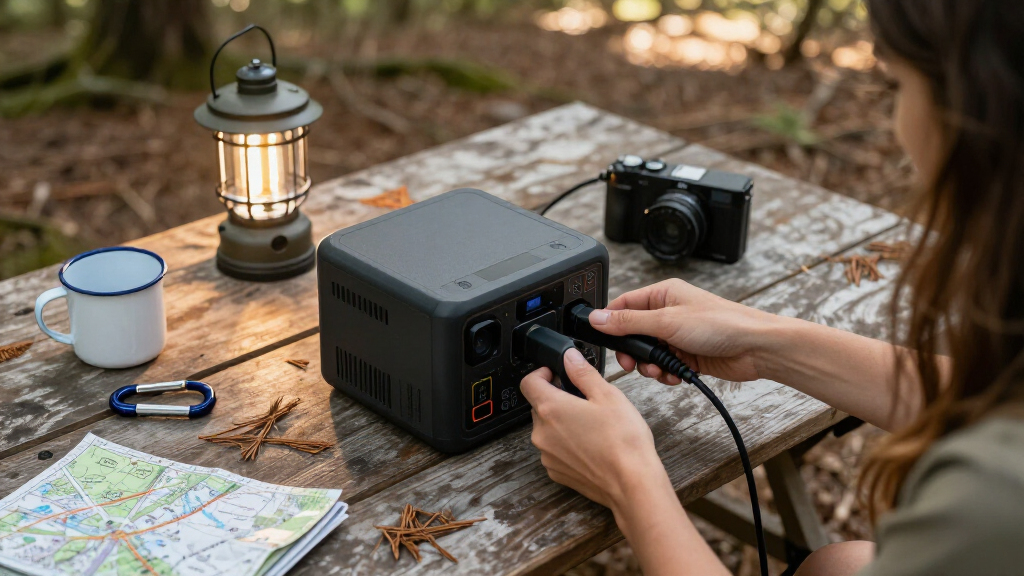
I evaluated every model through one lens: performance at a campsite, not on a spec sheet. That meant grouping the 15 units into three capacity classes (under 150Wh, 150–350Wh, and 1,000Wh+) and judging each against its intended trip length rather than against units in other classes. Within each class, I compared battery chemistry (LiFePO4 versus standard lithium-ion, which affects how many seasons the unit lasts), weight and packed size relative to a car-camping or backpacking loadout, continuous and surge output against common camping devices like kettles, fans, and CPAP machines, and recharge speed, which determines whether a solar panel can realistically top the unit up mid-trip.
Usability details broke ties: a readable display, pass-through charging, a well-designed carry handle, and silent operation matter more at a campsite than they do in a garage. Finally, I weighed versatility — whether the unit could pull double duty for home backup or van life without costing more than a purpose-built alternative. Products are ranked by how cleanly they fit their buyer, not by raw wattage, which is why some smaller units appear above larger, pricier ones.
Factors to Consider When Choosing Portable Power Stations For Camping
Choosing a camping power station is mostly a math problem with a few comfort variables attached. Before you compare a single spec, figure out what you actually plan to run at camp — because the gap between “charging two phones” and “running a 12V fridge all weekend” is roughly $700 and 15 pounds. These are the factors that should drive your decision.
Calculate Your Real Watt-Hour Budget
The most common mistake campers make is buying capacity they never use — or underbuying by half. Add up the watt-hours your devices actually draw: a phone recharge is about 15Wh, a laptop charge 50–60Wh, a 12V camping fridge can pull 400–600Wh per day, and an electric kettle drains 200Wh in a single boil. For a weekend of phone charges, lights, and one laptop session, a 250–300Wh unit is genuinely enough. Only move into the 1,000Wh class if you’re running refrigeration, CPAP equipment, or induction cooking, because that tier’s weight and cost are wasted on lighter loads. Remember that usable capacity is typically 85–90% of the rated figure, so build in a buffer rather than cutting it exact.
Battery Chemistry Determines How Many Seasons You Get
LiFePO4 (often labeled LFP) batteries handle 3,000-plus charge cycles before degrading to 80% capacity, while standard lithium-ion chemistry typically manages 500–800. For a camper who uses their station a dozen weekends a year, that difference is the line between a unit that lasts a decade and one that feels weak by year three. LFP also tolerates being stored partially charged and handles heat better, which matters when the unit sits in a hot car trunk between trips. The tradeoff is weight — LFP cells are slightly heavier per watt-hour, which is one reason the premium 1,000Wh units aren’t light. My advice: for anything you plan to keep beyond two seasons, treat LFP as non-negotiable, especially in the budget segment where older chemistry still hides.
Surge Rating Matters More Than You Think
Continuous wattage gets all the attention, but surge (or peak) rating is what decides whether your device turns on at all. Compressor fridges, electric blankets, pumps, and anything with a motor can draw two to three times their running wattage for a split second at startup. A 120W-class station with a 240W peak will simply refuse to start many of these devices, no matter how much battery remains. Match the surge rating against your single most demanding item before anything else — this one spec eliminates more mismatches than any other. If a kettle or heated blanket is on your packing list, you need at minimum a 300W-class unit with a 600W surge, and honestly, a 600W-plus output class is safer.
Weight, Size, and How You Actually Travel
Be honest about how the station gets from your car to the tent. Car campers can happily haul a 25-pound 1,000Wh unit 30 feet from trunk to picnic table, but anyone portaging a canoe, hiking to a dispersed site, or moving campsites daily will regret anything over 8 pounds. The 80–120Wh class exists precisely for this buyer — they clip to a pack and cover phone, headlamp, and camera charging for two or three days. Also check the physical form factor: a tall, narrow unit packs differently in a car bin than a wide, flat one, and a flimsy handle on a 10-pound unit is a real annoyance. Weight you won’t carry is weight you shouldn’t pay for.
Solar Input and Recharge Speed
Recharge speed is the difference between a one-trip battery and a system. If your wall recharge takes ten hours, the station sits dead most of the time at home; if it takes two, it’s always trip-ready. Units with fast AC charging (80% in under an hour and a half) also pair far better with solar, because a 100W panel can meaningfully refill a 300Wh unit during a camp day but barely dents a 1,000Wh one. Check the maximum solar input wattage — some budget units accept only 60W of panel, turning a “solar generator” label into marketing. If multi-day off-grid trips are the goal, prioritize high solar input alongside capacity, and budget for a panel, which usually isn’t included.
The Hidden Costs and Features That Earn Their Keep
Pass-through charging lets the station run devices while it recharges from solar — indispensable for multi-day trips and missing on some budget models. A bright, accurate display showing remaining watt-hours (not just a percentage bar) makes trip planning far easier than guesswork. Pure sine wave AC output protects sensitive electronics like CPAP machines and laptops, and it’s worth confirming on cheaper units. Finally, consider resale and ecosystem lock-in: extra batteries, matching solar panels, and app control only matter if you plan to build around one brand. Skip paying a premium for an app and expansions you’ll never configure.
Frequently Asked Questions
Will a 300Wh power station run a camping fridge overnight?
For most 12V compressor fridges, yes — a single overnight is realistic, but a full weekend is not. A typical 40–50L camping fridge draws roughly 40–60Wh overnight in mild temperatures, so a 288–300Wh unit like the Anker SOLIX C300 or VTOMAN FlashSpeed 300 can cover one to two nights with power to spare for phone charging. The bigger risk isn’t average draw but startup surge: compressor kick-on can briefly demand two to three times running wattage, so verify your fridge’s surge figure stays under the station’s peak rating. For trips longer than two nights, either pair a 300Wh unit with a 100W solar panel or step up to a 500Wh-plus model like the GRECELL 519Wh.
Is a small 88–120Wh station actually useful, or should I just bring a power bank?
A small station earns its place the moment you need AC power or sustained 12V output — that’s the line a power bank can’t cross. The MARBERO 88Wh and HOWEASY 120W units will run a small fan, a string of camp lights, or a laptop charger where a USB power bank cannot, and their built-in inverters and displays make load management simpler. That said, for pure phone and headlamp charging, a 20,000mAh power bank weighs less, costs less, and charges faster from the wall. Treat the small-station class as an AC-and-12V solution, not a big battery. If your packing list contains only USB devices, skip this class entirely.
Can I bring a portable power station on a flight or is it only for car camping?
Almost every unit in this roundup is flight-restricted. Airline rules cap lithium batteries at 100Wh for carry-on without airline approval, and 100–160Wh requires prior permission — which covers only the smallest models like the MARBERO 88Wh and Daran 89.6Wh, and even then you should confirm with your carrier. Anything 150Wh or larger, including the entire 1,000Wh class, cannot fly at all. For fly-in camping trips, plan to charge a sub-100Wh unit at your destination or arrange gear rental locally. For everything else — car camping, RVs, van life, canoe trips — these units travel without restriction, though you should avoid leaving any of them in a hot parked car for extended periods.
How much solar panel wattage do I need to keep a power station charged at camp?
Is it worth paying more for a 1,000Wh station if I mostly do weekend trips?
Usually not — and the extra 15-plus pounds are the reason. If your weekend load is phones, lights, a laptop, and maybe a fan, a 300Wh unit covers it with headroom, recharges from the wall fast, and moves from car to tent without effort. The 1,000Wh class (Anker C1000 Gen 2, BLUETTI AC180, Jackery Explorer 1000 v2) pays off when refrigeration, CPAP machines, electric cooking, or multi-day stretches without grid power enter the picture, and it doubles as legitimate home backup during outages. That second use case is honestly what justifies the price for most buyers. But if camping is the only job, buy the capacity you need and spend the savings on a good solar panel instead — that combo delivers more usable off-grid days per dollar than raw battery size alone.
Conclusion
The right pick depends less on specs and more on how you camp. For the best overall, the Anker SOLIX C1000 Gen 2 is the most complete package — big capacity, fast recharging, and enough output for a full base camp. The BLUETTI AC180 sits just behind it and suits campers who prioritize maximum AC output and solar input; the Jackery Explorer 1000 v2 is the pick if you want that capacity class in a friendlier, lighter package.
For best value, the GRECELL 519Wh delivers weekend-capacity power at mid-pack pricing, with the VTOMAN FlashSpeed 300 as the value pick in the compact class thanks to its LFP chemistry. Beginners should start with the Anker SOLIX C300 — its intuitive display, app support, and right-sized capacity teach good power habits without overwhelming anyone. For minimalists and backpack-style campers, the MARBERO 88Wh or Daran 89.6Wh cover the essentials at carry-anywhere weights. And for campers with a specific high-draw need — a fridge, a CPAP, an electric kettle — the BLUETTI Elite 30 V2’s 600W output in a 288Wh body is the clever middle path. Whatever you choose, match the capacity to your real packing list, insist on LFP chemistry for anything you’ll keep past two seasons, and add a solar panel before you add another battery.
Halloween Picks
halloween
As an affiliate, we earn on qualifying purchases.