

TL;DR

Get travel and outdoor gear delivered free with Prime
- Fast, free delivery on millions of items
- Prime Video, Amazon Music and more included
- Member-only deals all year
Moving your rig into a closet or separate room is the most effective way to reduce noise. Proper placement, ventilation, and targeted treatment make a big difference in sound and heat management.
Acoustic dampening
& the rig in the closet.
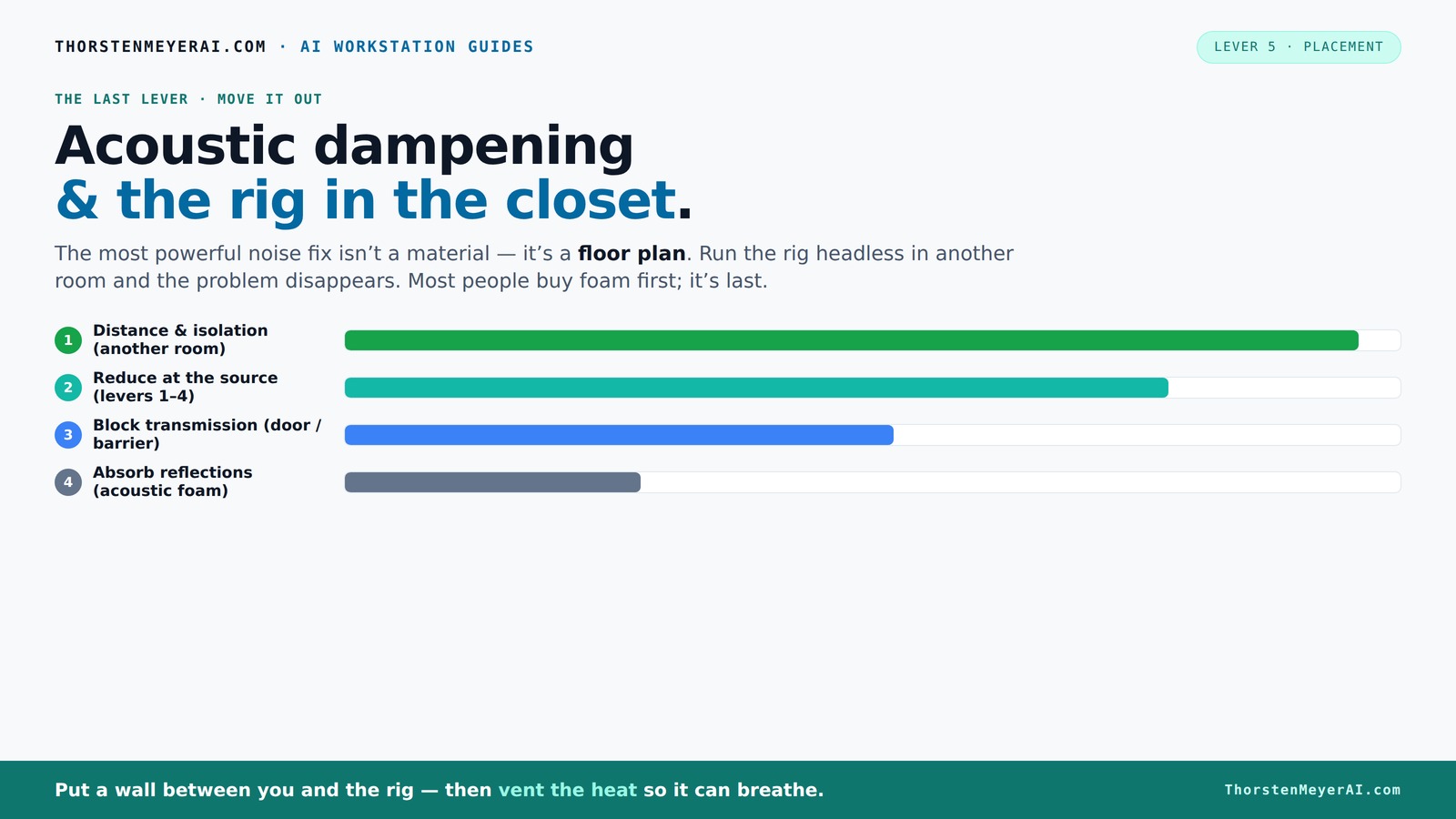
The most powerful noise fix isn’t a material — it’s a floor plan. A rig you can’t hear because it’s in another room beats any amount of foam. Tap the approaches in Part 1 to see what actually works.
(another room)
(levers 1–4)
(door / barrier)
(acoustic foam)
Contain the noise, not the heat
Key Takeaways
- Moving your rig into another room or closet is the most effective way to reduce noise without treatment.
- Ensure proper ventilation—active airflow prevents heat buildup that can throttle performance.
- Focus acoustic treatment on first reflection points and corners—20-40% coverage is usually enough.
- Seal gaps and vents to prevent sound leaks, but balance this with heat dissipation needs.
- Adjust treatment and placement based on your specific use case—vocals, AI, or instruments.
soundproof closet for audio equipment
As an affiliate, we earn on qualifying purchases.
As an affiliate, we earn on qualifying purchases.
Why Moving Your Rig Is the #1 Way to Cut Noise
The simplest, most effective fix for noisy rigs? Distance. Moving your machine into another room or closet can cut noise by 20-30 decibels—sometimes more—without any foam or acoustic panels.
Imagine your GPU rig humming loudly on your desk. Now picture it tucked away in a closet across the hall. The sound difference is immediate. You don’t need fancy treatment; you just need to put physical space between you and the noise source.
This works especially well with AI workstations, where you mostly communicate over the network. Your laptop or thin client stays on your desk, while the loud hardware roars quietly in another room. That’s the power of good placement.
The 'Rig in the Closet' Setup: How to Do It Without Melting Your Hardware
Placing a hot, powerful machine inside a closet sounds perfect—quiet and out of sight—but heat buildup is the biggest challenge. Trapped heat causes thermal throttling, which makes fans roar louder and reduces performance.
To avoid this, ventilation is key. You need to create a flow of air. A simple passive vent or a small exhaust fan can help hot air escape. For more serious setups, a dedicated soundproof enclosure with ducted airflow and temperature controls is the way to go.
In fact, many commercial soundproof cabinets incorporate active cooling and airtight seals, balancing noise reduction with heat dissipation. These units typically use thermostats and ducting to keep the environment stable, preventing overheating while muffling noise. Check out this guide for detailed ventilation strategies.
Acoustic Dampening: What Really Works Inside a Closet
Acoustic dampening isn’t just about blocking sound; it’s about managing how sound waves behave inside a small space. In a closet, reflections and echoes can make noise seem louder and harsher, which can be distracting or even cause audio distortion. Effective treatment involves understanding how sound interacts with surfaces, and why some materials work better than others.
Start by identifying the primary reflection points—these are the spots where sound bounces directly from your speakers or microphone to your ears or recording device. Installing foam panels at these points reduces early reflections that cause echo and comb-filtering, which can muddy your audio or make monitoring less accurate. Bass traps in corners are crucial because low frequencies tend to accumulate and create boomy, muddy sound; trapping these frequencies prevents them from dominating your sound profile.
Using rugs and blankets softens the overall acoustic response, but they won’t prevent sound from leaking out. For controlling sound transmission, sealing gaps and adding mass—like drywall or specialized soundproofing materials—is necessary. Covering about 20-40% of the wall surface with treatment strikes a balance: it reduces problematic reflections without deadening the space, which is important for keeping your setup lively enough for accurate monitoring and recording.
Placement Tips: Where to Put Panels, Bass Traps, and the Mic
Strategic placement is essential because it targets the primary sources of reflection and resonance. The first reflection points are the most critical—these are the spots where sound waves bounce directly from your speakers or mic to your ears or recording device. Using a mirror trick—sit in your usual spot and move a mirror along the wall—you can identify these points visually. When you see the speaker or mic in the mirror, that’s where a panel should go. Proper placement reduces early reflections that cause comb filtering, resulting in clearer, more accurate sound.
Next, treat the wall directly behind your microphone. This surface often acts as a reflection point, introducing harshness and coloration to recordings. Bass traps should be placed in the corners where low frequencies tend to build up, which can cause boomy or muddy sound if left untreated. If echo or lingering reflections persist, consider ceiling panels, but only after addressing the most critical reflection points.
Think of your space as an acoustic puzzle—each panel and trap should be positioned where it will have the most impact on sound quality. Refer to guides like this for detailed placement strategies tailored to small spaces.
How Much Treatment Is Enough? The 20-40% Rule
In small spaces, over-treating can deaden the sound, making the room feel hollow or unnatural, while under-treating leaves reflections and echoes that impair clarity. The 20-40% rule provides a practical guideline: covering roughly one-fifth to two-fifths of the surface area with acoustic panels and bass traps balances absorption and liveliness. This coverage significantly reduces problematic reflections, improves clarity, and maintains a natural sound within the space.
For vocal booths or recording spaces within closets, near-total coverage—up to 40%—can be beneficial, especially to tame harshness and reverberation. For general AI rigs or workspaces, partial coverage—around 20-30%—often suffices to control echo and resonance without making the room sound dead.
Assess your space by measuring the wall areas and considering your primary use. For example, if you notice harsh echo or muddiness, increase coverage gradually. The goal is to find a balance where sound is controlled but still natural, avoiding the trap of making the environment too dead or sterile.
Common Pitfalls: Gaps, Vents, and Too Much Foam
Gaps, cracks, and vents in your closet compromise your soundproofing efforts by allowing sound to escape and leak out, which defeats the purpose of treatment. Sealing these spaces with weatherstripping, acoustic sealant, or mass-loaded vinyl can help improve your soundproofing.ces containment. Doors are often weak points—adding a heavy door or specialized acoustic seal can dramatically reduce sound leaks, but remember that perfect sealing can trap heat, so ventilation must be carefully managed.
Overusing foam or absorption materials can deaden the room, making it sound hollow and unnatural. Excessive treatment absorbs too much sound energy, reducing room liveliness and making audio monitoring less accurate. Focus treatment on reflection points and corners, where it will have the greatest impact. Remember, the goal isn’t total silence but a controlled, balanced acoustic environment that enhances clarity without creating a dull or overly dead space.
Ventilation is also crucial—if your rig runs continuously, you need airflow to prevent overheating. Solutions like ducted airflow or soundproof cabinets with active cooling strike a balance between sound isolation and heat dissipation. For detailed approaches, see [this](https://thorstenmeyerai.com/low-noise-pc-cases-airflow/) guide.
Budget Tiers: From DIY to Professional Soundproofing
On a tight budget? Use moving blankets, thick rugs, and DIY panels from foam or fiberglass. While these options may not offer perfect sound isolation, they can significantly reduce noise reflections and echo, creating a more controlled environment. The key is proper placement—target reflection points and corners—to maximize their effectiveness without overspending.
For a mid-range setup, incorporate bass traps, higher-quality acoustic panels, and sealing solutions. These provide better clarity, reduce harshness, and improve overall sound quality, making your space more professional and functional.
High-end solutions involve custom-built soundproof cabinets with active cooling, ducted airflow, and heavy insulation materials. These are costly but essential for professional-grade recording or high-stakes AI work where minimal noise and optimal thermal management are critical. Investing in such solutions yields the best performance but requires careful planning and budget.
Check out [this detailed guide](https://thorstenmeyerai.com/reduce-heat-noise-ai-workstation/) for specific product recommendations and DIY tips tailored to different budget levels.
Use-Case Specific Advice: Vocal, AI, or General Recording
Vocal booths benefit from heavy absorption—panels on walls and ceiling, bass traps in corners, and a reflection filter around the mic. The goal is to tame harshness, echo, and unwanted resonance that can color recordings. Treating these reflection points ensures cleaner, more professional vocals and reduces post-processing time.
For AI rigs, the main focus should be on placement and ventilation. Sound treatment is secondary because most noise stems from structure-borne vibrations, leaks, or fans. Using rubber feet, seals, and partial panels helps control reflections without overly deadening the environment. Proper airflow management prevents overheating, which is critical for sustained high-performance operation.
Guitar or instrument closets require bass traps and diffusion to manage low frequencies and prevent sound bouncing around. Tailoring treatment to your specific use case ensures maximum efficiency—whether it’s capturing clear vocals, maintaining quiet operation, or preventing low-frequency booms.
Remember: treat the room for what’s most important—whether it’s reducing echo, controlling noise leaks, or managing low frequencies. Prioritize your needs to avoid unnecessary treatment that adds cost and complexity.
Frequently Asked Questions
What is the difference between soundproofing and acoustic treatment?
Soundproofing keeps sound in or out by sealing gaps and adding mass, while acoustic treatment improves how the room sounds inside by reducing reflections and echo. Both are important but serve different purposes.
Can I really turn a closet into a recording booth?
Yes, with proper reflection control, sealing gaps, and adding absorption, a closet can become a surprisingly effective vocal booth. It’s all about balancing treatment and ventilation.
Where should acoustic panels go inside a closet?
Start with the first reflection points on side walls and behind the mic. Add bass traps in corners and treat the ceiling if echo persists. Use a mirror trick to find key reflection spots.
Do I need bass traps in a closet?
Yes, bass traps in the corners help tame low-frequency buildup, which is common in small enclosed spaces. They improve clarity for vocals and reduce boomy sounds.
How much wall coverage is enough?
Typically, 20-40% coverage with panels and traps balances absorption and room liveliness. Adjust based on your specific space and use case.
Conclusion
Your best bet for a quiet, cool setup isn’t just foam or panels. It’s moving your gear out of earshot, ventilating it smartly, and treating the space where reflections matter most. Think of your closet as a mini studio: with the right placement and airflow, it becomes a powerhouse of productivity—silent and cool.
Remember, the goal isn’t total silence but controlled sound and reliable performance. When you master placement and ventilation, your closet rig becomes a secret weapon, not a noisy liability.
Halloween Picks
halloween
As an affiliate, we earn on qualifying purchases.